The steady hand: Inside crisis prevention
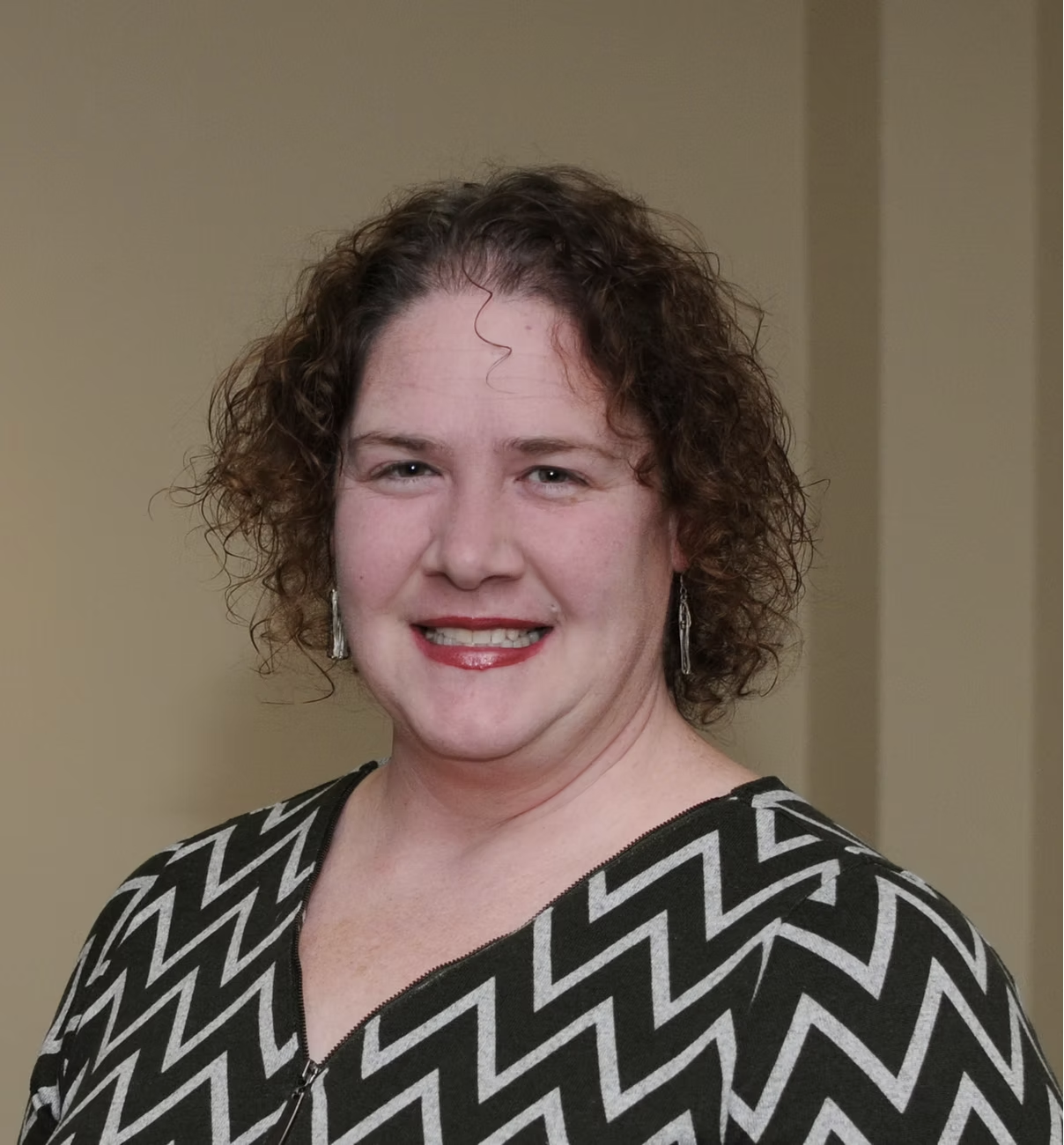

By midmorning, the rhythm of Erin Beasley's day had settled into a routine cadence.
The comforting scent of maple candles filled the office she shares with her colleague, Renee Whitling.
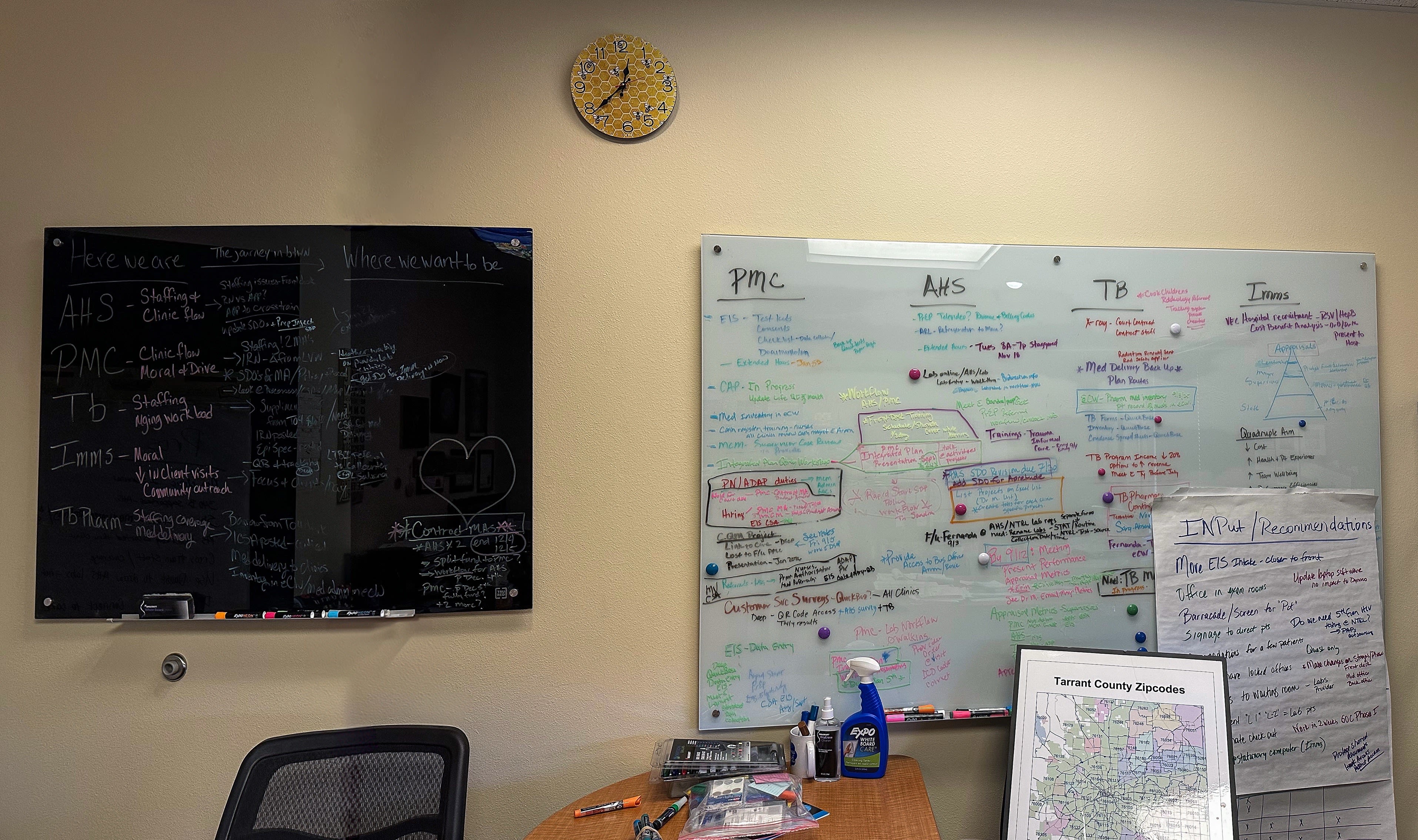
Two large boards were illuminated by the warm office light and covered in vibrant handwriting. They documented the ten clinics Beasley oversees. Each is tied to critical grant funding, deadlines and deliverables that dictate the daily operations of the Tarrant County Public Health (TCPH) Immunization Division.
As the two women typed in unison, the keyboard clacks created a steady background, punctuated by discussions about which clinics require immediate assistance.
"What do we need most this week?" Beasley asked as her gaze swept over the whiteboards. Her voice conveyed a calm yet decisive authority — a tone that sets a purposeful pace for the day. Papers and printed-out emails covered the desk, while conversations flowed seamlessly between clinic schedules, outreach initiatives and grant reports.
The atmosphere was anything but rushed. Instead, it hummed with a quiet, methodical energy.

As the manager of the Immunization Division at TCPH, Beasley oversees a network of ten public clinics and a community outreach program aimed at providing efficient immunization services across the county. Though her contributions go largely unseen by the public, residents benefit from the smoother systems and better access to care that arise from her tireless efforts behind the scenes.
"I always say, 'I want to work myself out of a job,'" Beasley said. "I want to know that I could be gone, and everything would run smoothly. I want the supervisors [of the clinics] to be able to lead without needing me."
After spending 15 years navigating hospital corridors, she understands that calmness is not the lack of urgency but rather a skill to guide others through it. The same composure that once carried her through cardiac emergencies now shapes how she leads teams, solves problems and finds order in work that rarely slows down.
Service as a constant
For Beasley, service has never been just a job description. She grew up watching her parents work as missionaries, often in communities where care was presented with few resources but deep commitment.
"Helping people was just part of what life looked like," she said. "You didn't do it for recognition. You did it because someone needed you."
That mindset followed her into nursing school, where she realized that service and skill were intertwined. She found that caring for others required both compassion and control.
She remembers how quickly the rhythm of the cardiac floor could change. One minute, she was charting vitals; the next, someone called for help.
"You had to make decisions fast," she said. "There wasn't time to second-guess."
The alarms, the urgency and the coordinated movement of the staff demanded total focus. She learned to maintain an even tone to be the calm in the noise so others could follow her lead.
"You don't think about it in the moment," she said. "You just do what needs to be done."
Several years later, Beasley's calm took on a new purpose as a manager in the neuro-unit. She was no longer just part of the response. She was directing it. When the floor became busy, she anchored herself at the center, checking in with nurses, giving quiet direction and keeping the pace secure. The work was still urgent, but her focus had shifted to the team's cadence as much as her own. She found balance in knowing when to step in and when to let her team function independently. Holding her ground meant making space for others to do the same.
Still, something about the hospital's rhythm began to feel incomplete. She excelled at reacting, but she wanted to understand what occurred before patients reached the hospital beds.
Beyond the hospital
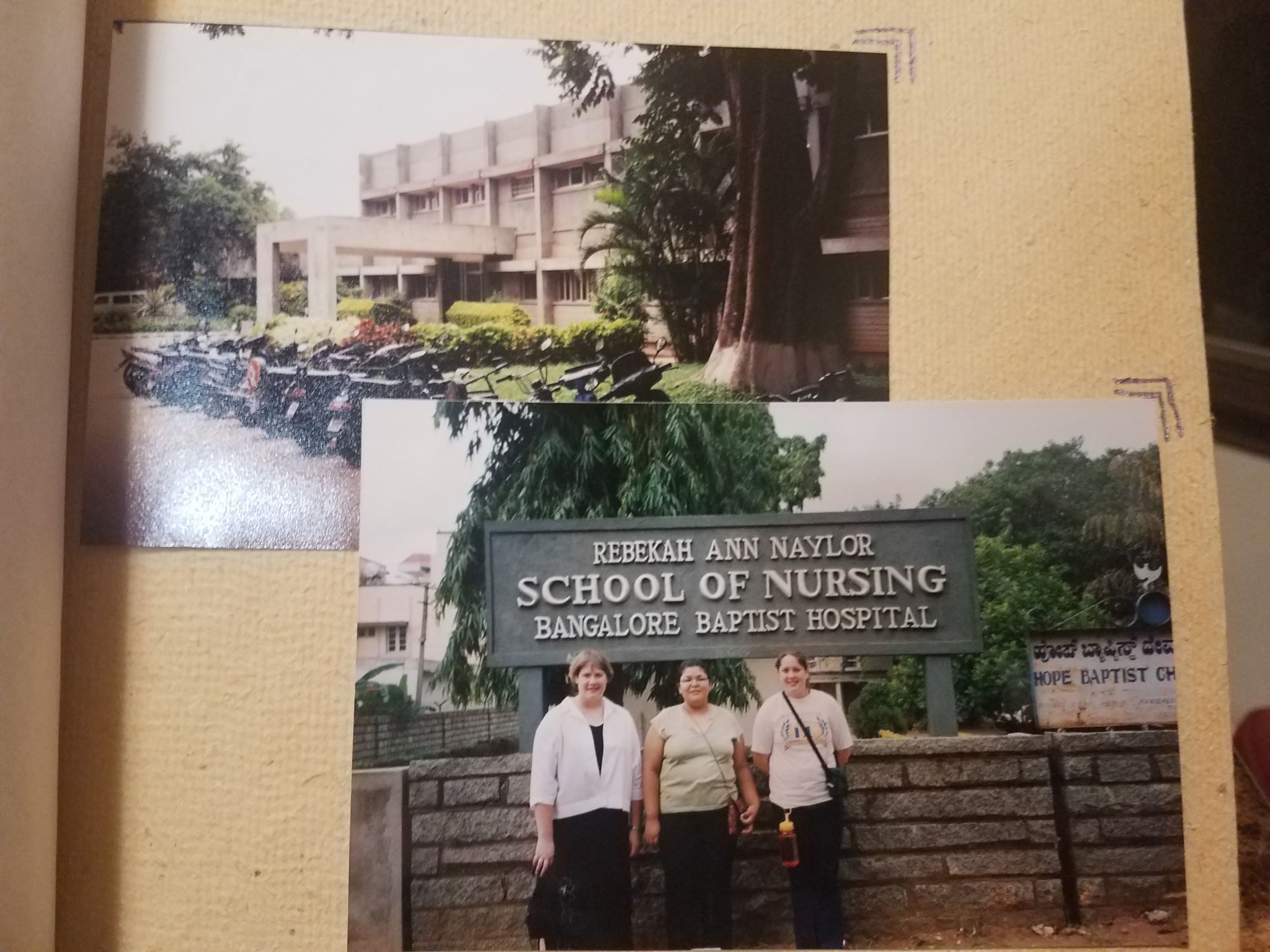
As a student nurse, Beasley embarked on her first mission trip to a hospital in India supported by local ministries. The experience reshaped her understanding of care. Families were not separated from the patients. They became part of the healing process.
"You had your baby, we moved you in, and the whole family took care of you," she said. "The nurses would simply check in to make sure everything was going well."
Supplies were limited. When something ran out, a family member would take a ticket to the supply counter or market to replenish what was needed.
"They would buy the supplies and bring them back so we could keep going," she said. "It looked nothing like what I knew at home, but it worked because everyone took ownership."
Witnessing this collective effort left her both amazed and humbled. What initially seemed disorganized revealed a deep sense of trust and showed that effective care could thrive without the traditional, western structure.
That sense of mutual responsibility stuck with her.
"Where I was, it was very community-based," she said. "I liked that style. Everyone had a role."
Since then, this approach has influenced her own leadership.
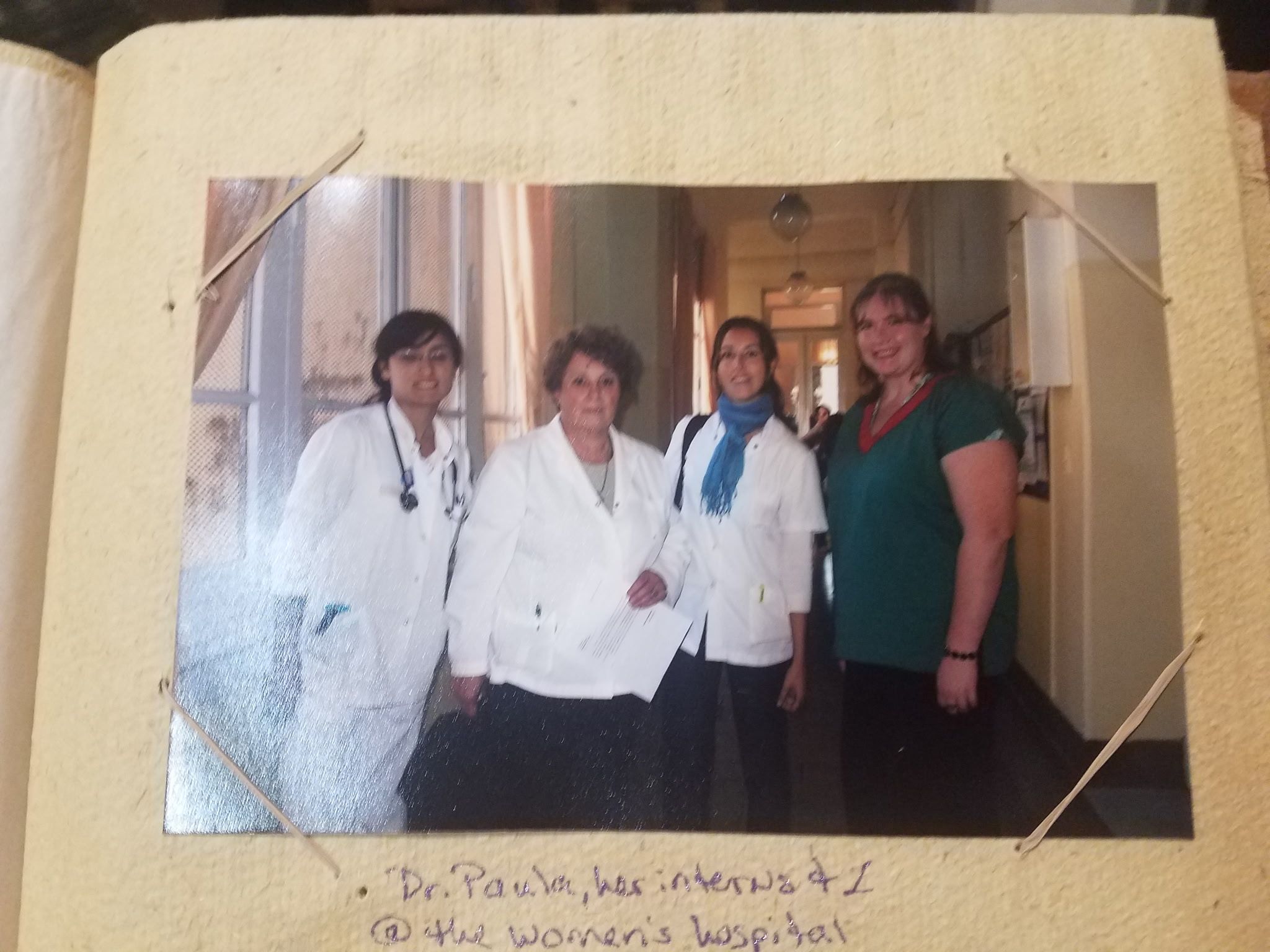
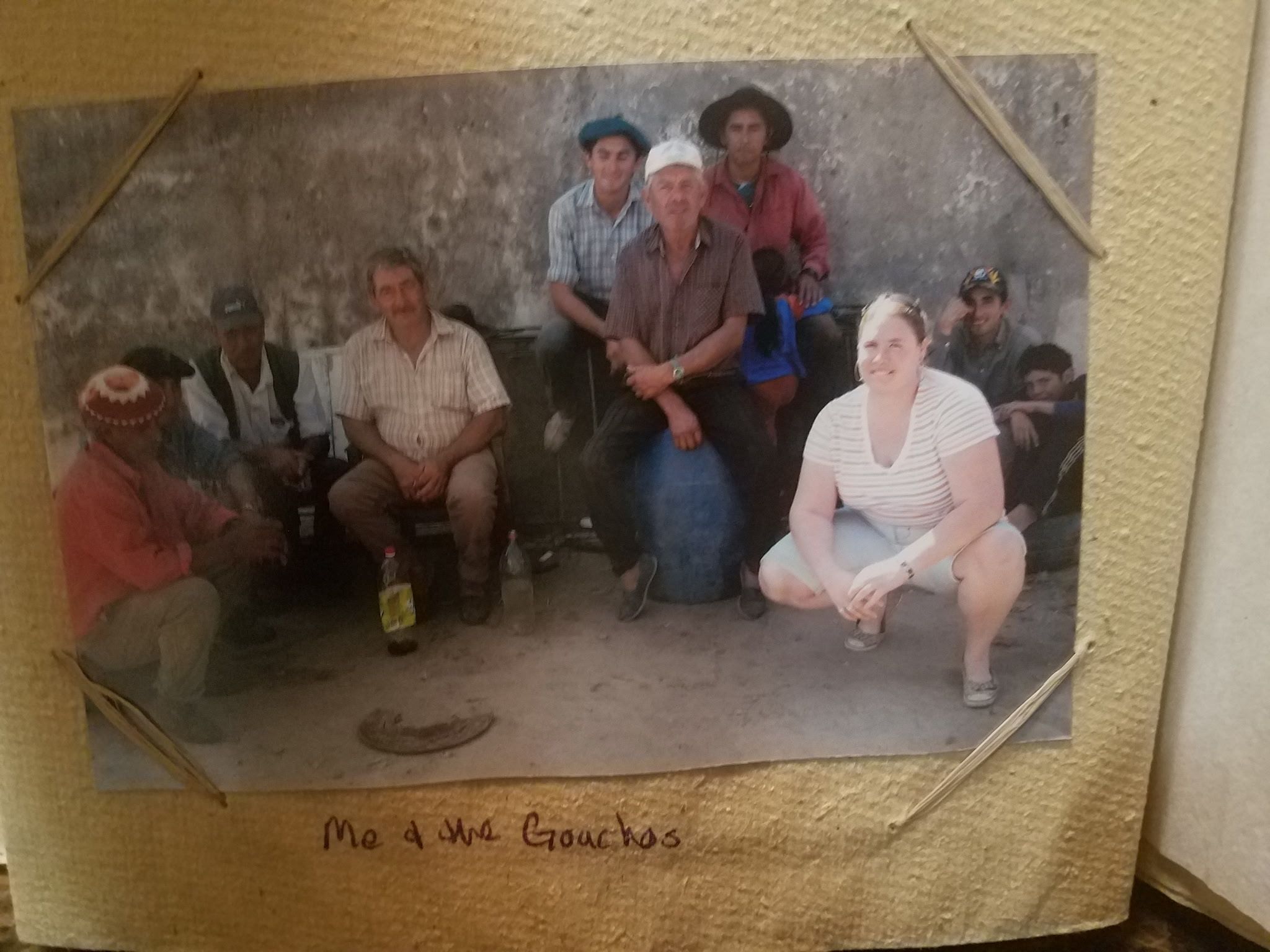
A few years later, Beasley accompanied a physician to Argentina, where she encountered an entirely different healthcare system. One in which health care was guaranteed, but resources were stretched thin.
"In Argentina, they have socialized medicine," she said. "You may have a broken leg and sit in the ER for nine hours before you can get surgery because there are two or three people ahead of you. But you don't have to pay for it."
The waits could be long and exhausting, but what struck her was the patience in the room and the understanding that access mattered as much as speed. This approach made her think about fairness and how privilege shapes care in unexpected ways.
In both countries, space was a luxury. In India, the wards were large and filled with families who stayed to help care for their loved ones. Relatives gathered at bedsides, children played quietly in corners and nurses weaved in between rooms, only aiding when needed. In Argentina, the waiting rooms were always busy. Patients would sit shoulder to shoulder for hours, hoping to be seen before the day’s end. Beasley noticed that despite the crowd, the staff maintained a peaceful focus. The work was relentless, yet their commitment never wavered.
"That dedication struck me," she said. "Both places had some of the most beautiful nurses and [most] incredible doctors I've ever met."
Ultimately, she realized that good care relies not on the system but on the people within it. Nurses and families consistently found ways to make things work, even in the face of scarcity.

Finding prevention
The lessons from those trips stayed with her.
"From those experiences, I learned how to meet people where they are," she said. "You can't always change the barriers, but you can reduce them."
Over time, that question — how to make care accessible before it becomes an emergency — became a kind of compass.
Once she returned to Texas, she began contemplating prevention more seriously. While her hospital training centered on immediate responses, her goal shifted to understanding the circumstances that led to crises. "I wanted to help people before they ended up in a crisis," she said.
When the opportunity to manage the Immunization Division at TCPH opened, she hesitated. Her career had been rooted in bedside care, and the language of policy felt unfamiliar.
"I didn't feel qualified at all," she said. "I really didn't think I would get it."
Nevertheless, the more she read about the job, the more it aligned with everything she valued: accessibility, prevention and community connection.
Beasley took the leap. The transition was not quick, but it was intentional. She carried the insights of a nurse who had witnessed the effects of system failures. At TCPH, she shifted from following someone else’s perogative to crafting her own plans.
"In the hospital, everything is immediate," she said. "Here, you're planning months ahead. It's a different kind of pressure."
TCPH's network reflects this strategic approach. The department operates several specialized clinics that extend beyond routine immunizations. The Adult Health Services Clinic (AHS) provides testing, education and treatment for sexually transmitted diseases, while the Preventive Medicine Clinic (PMC) offers medical care and case management for adults living with HIV. The Refugee Health Clinic (RHC) focuses on tuberculosis screening and vaccination for newly arrived residents, and the Tuberculosis (TB) Elimination program works to prevent and treat TB through testing, treatment and community education. Together, these services act as a proactive front line to address health issues before they escalate.

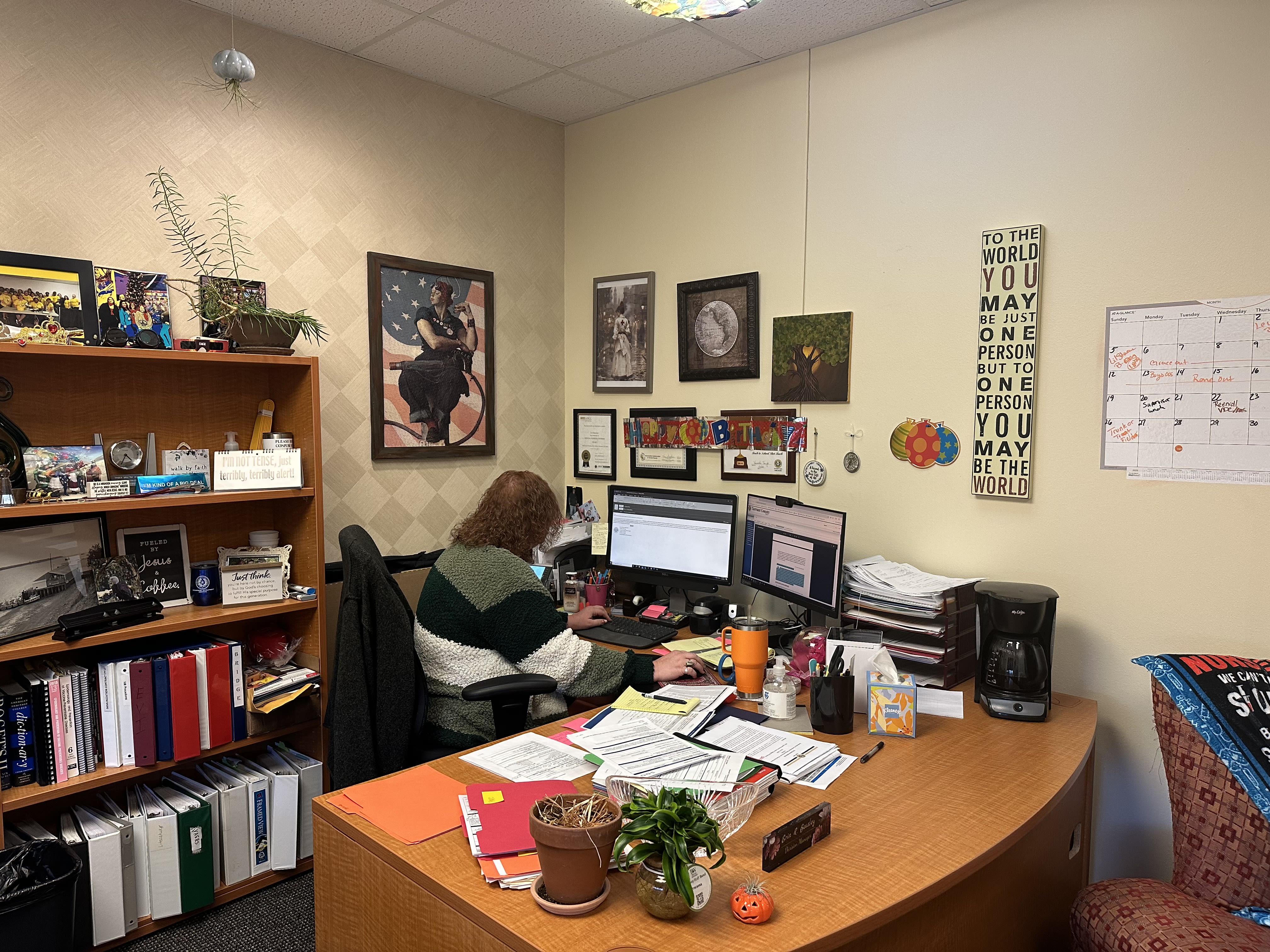
Erin Beasley working at her office desk (Cecilia Murphy)
Erin Beasley working at her office desk (Cecilia Murphy)
Inside her office, that pressure is visible in motion. The whiteboards detailed tasks and deadlines, but her conversations revolved around people: supervisors, outreach coordinators and nurses at clinics across the county.
"How do we make this smoother?" she asked Whitling. They move easily between topics such as budget adjustments, staffing shortages and community needs, troubleshooting problems as they arise.
The Associate Director for Family Health Services, Dr. J'Vonnah Maryman, has witnessed Beasley strengthen the division by emphasizing effective practices.
"She is moving more towards incorporating practices and strategies that have been shown to improve immunization rates," Maryman said. "Things like reminder–recall systems or not requiring appointments. Those are all strategies proven to reduce barriers."
The meeting table
At a monthly leadership meeting at TCPH, staff members gathered in a conference room at tables. The room buzzed with quiet conversation and the rich aroma of hazelnut coffee filled the air. Each person was equipped with a notebook and a pen, ready to capture key insights. Laughter filled the air as a light-hearted debate emerged over which side of the room is warmer on this chilly afternoon. Everyone agreed it is the left, where Beasley sat.
The meeting began with an icebreaker: rock-paper-scissors. "Wait, is it 'rock, paper, scissors, shoot' or just 'rock, paper, scissors'?" a woman from the back row asked. This question riled up the room. After some deliberation, the group decided on “no shoot,” and the game continued until one champion remained. Only then could the meeting begin.
Dr. Byrd, the department's director, leaned against the front table, addressing the staff.
"People are angry because they are scared," he said. "We need to find out why they're scared to know how to help them." His presentation centered on customer service — a quality rarely associated with public health.
The room quieted. Beasley nodded slightly and began to write. Around the room, pens scratched and chairs shifted. A slide on the screen listed "SOFT SKILLS" in bold letters: listening, empathy, body language.
Throughout the meeting, Beasley listened more than she spoke. When she did contribute, it was with clear questions or providing concrete insights.
"That presentation worked because it was honest. We didn't learn the usual customer service language," she said when questioned about a customer service training the staff had attended. "It was just good people and communication skills. It didn't feel rehearsed." Heads nodded. A colleague across the table murmurred agreement.
By the end of the meeting, the atmosphere lightened as staff gathered their notes and unfinished coffees. Beasley stayed behind for a moment to talk with two colleagues about staffing for next week's agenda. Once back in her office, she found the maple candle still burning and crossed off a task in her planner, opened a new email and continued her work. Even during her lunch break, Beasley remained at her desk, discussing clinic operations with Whitling.
"We just keep things moving," she said.
A team leader
Beasley’s commitment to the community starts with her team. Each August, TCPH hosts Shot Rush, a back-to-school immunization initiative that transforms community centers across Tarrant County into clinics where thousands of families gather for vaccinations before the school year starts.
The workday starts before sunrise as staff set up tables and checklists. Coolers packed with vaccines line the walls, ready for the first wave of families. Beasley calls it “controlled chaos,” a rhythm reliant on each individual's contribution. “It means people are showing up [for the community],” she explained.
The Associate Director of Health Protection and Response, Sabrina Vidaurri and Beasley have spent years coordinating everything from emergency activations to countywide vaccination events.
“Erin is a collaborative leader, and that’s what I appreciate about her,” Vidaurri said. “She’s great at giving direction to her teams but also leaves space for people to speak up when something isn’t quite right.”
Jessie Allen, an administrative assistant who has worked alongside Beasley since 2019, said that same steadiness defines their partnership.
“She is amazing,” Allen said. “She’s not a micromanager. She gives you a task and just expects you to get it done. If she has to follow up in two weeks because it’s still not done, then something’s wrong with you, not her style.”
Allen credits Beasley’s leadership style for shaping her own approach: “I’ve learned from her,” she said. “I send my staff their tasks and expect the same accountability. It’s something she modeled for me.”
During Shot Rush, the pace remained relentless as families navigate clinics for hours at a time, and the three women work to ensure the process runs smoothly. The center was lively with children's chatter. Beasley monitors operations from start to finish, checking in with nurses, answering questions and making adjustments when needed. Events like this reflect the same promise that shapes all of her work: making care easier for the community before they ever reach a crisis. The days are long, but her composure never slips.
That consistency, Vidaurri said, is what keeps things on track when the workload spikes or schedules shift.
“Erin walks the walk,” Vidaurri said. “She’s one of those people who just helps in every way she can.”
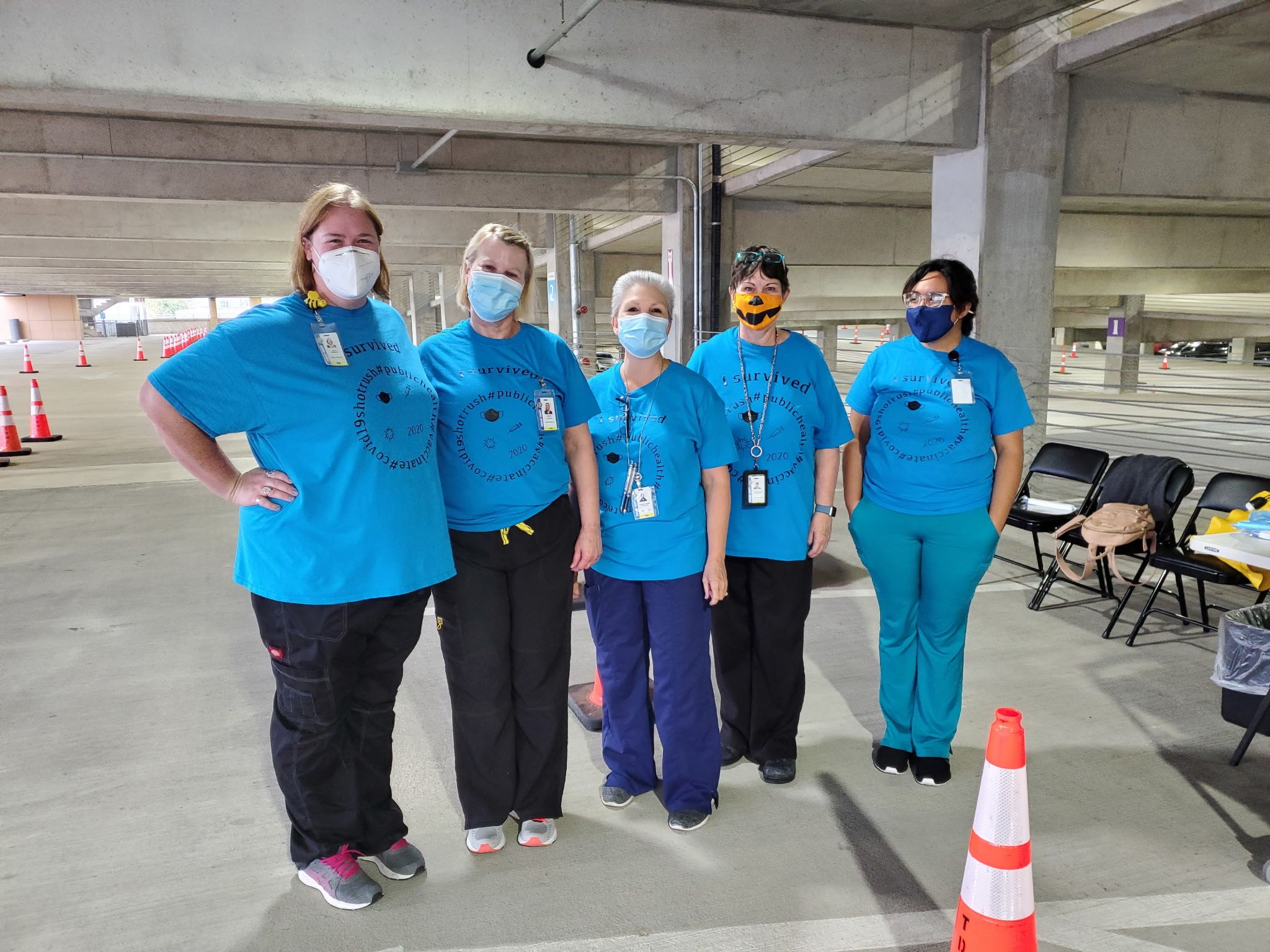
Beasley and TCPH staff at Shot Rush 2020 (Erin Beasley)
Beasley and TCPH staff at Shot Rush 2020 (Erin Beasley)

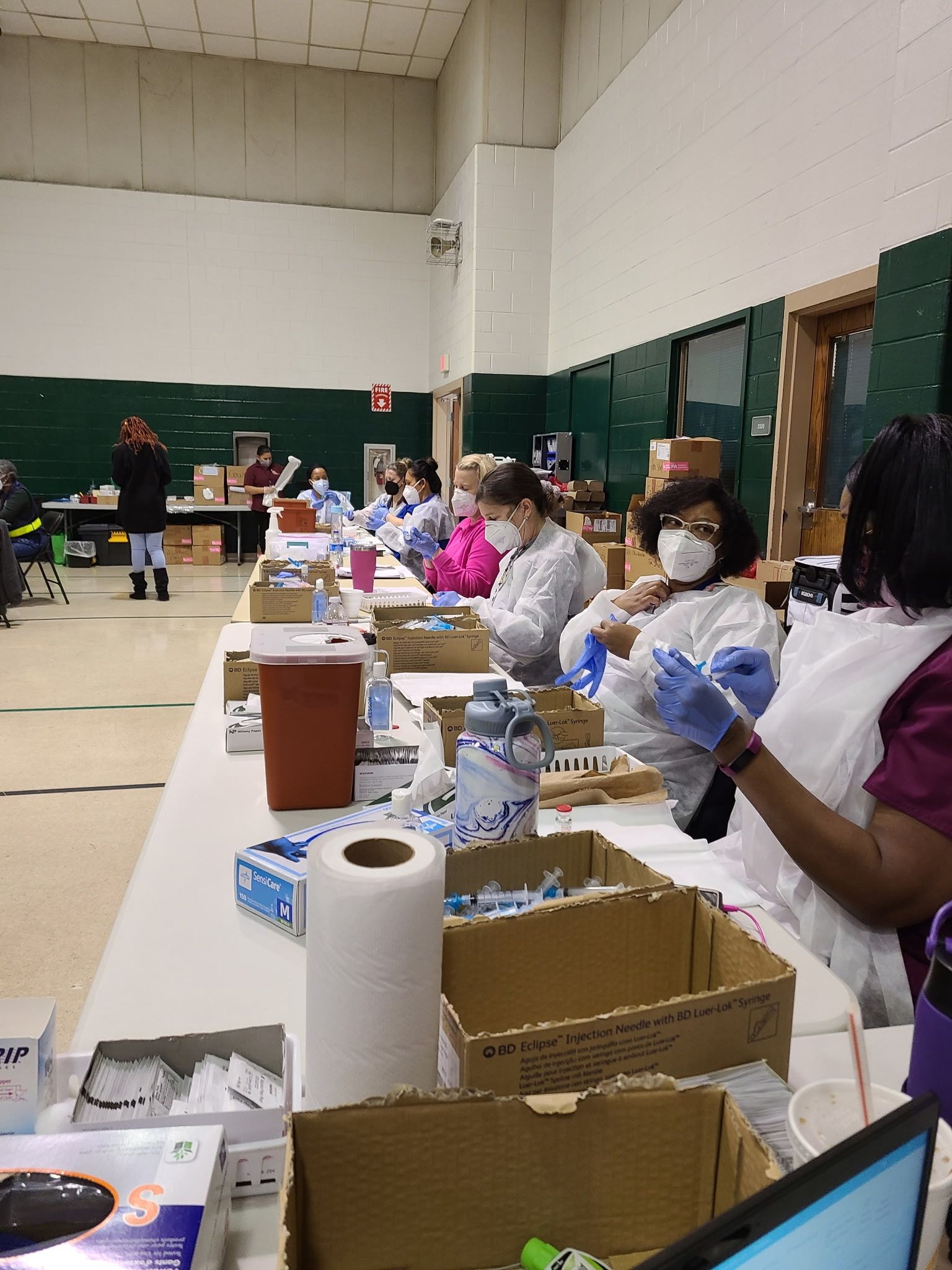
Shot Rush (2020) workers preparing for the day (Erin Beasley)
Shot Rush (2020) workers preparing for the day (Erin Beasley)
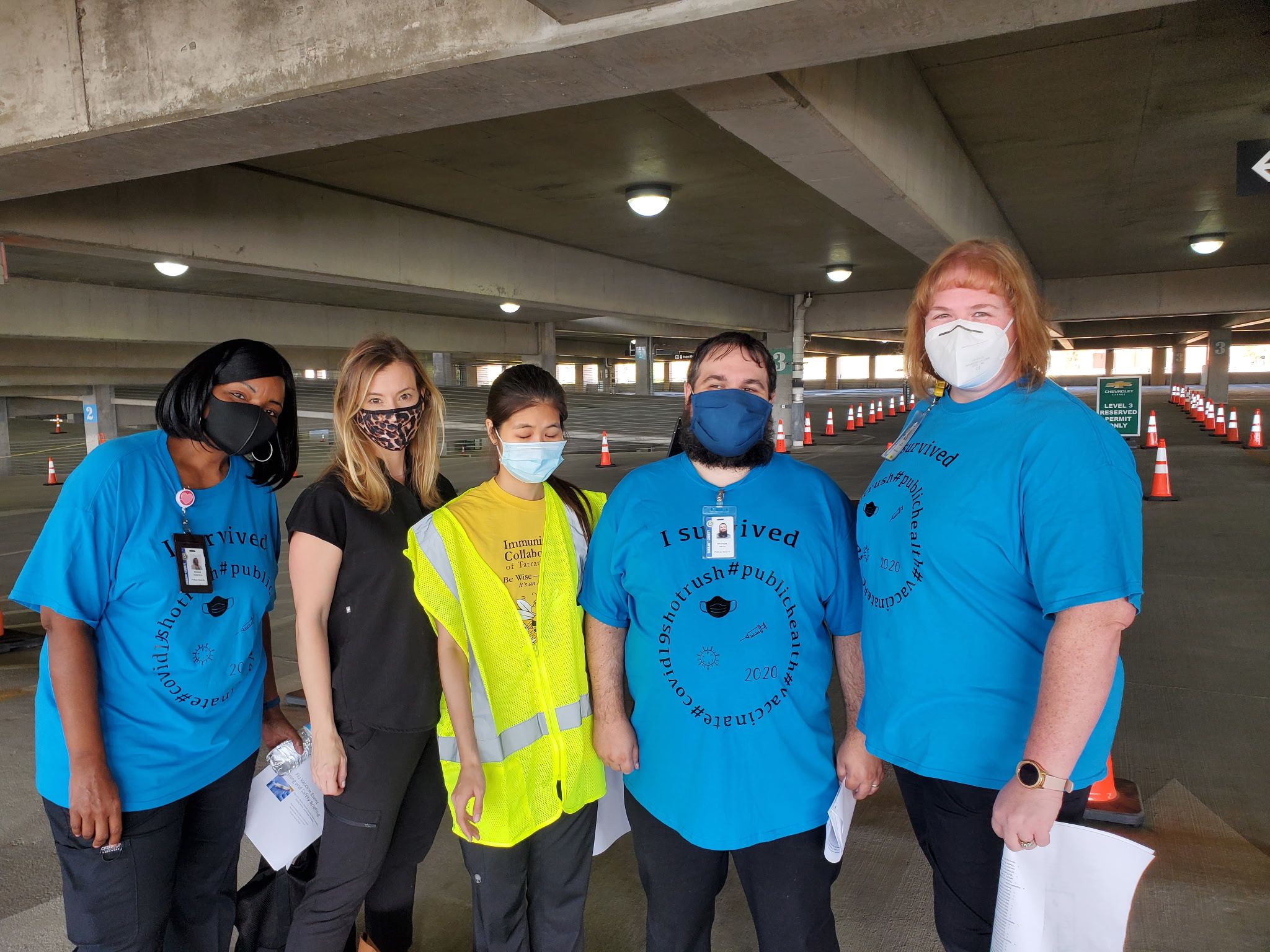
Beasley and volunteers at Shot Rush 2020
Beasley and volunteers at Shot Rush 2020
Innovation and impact
In a time of crisis, creativity emerged as a beacon of hope. Erin Beasley’s innovative approach to public health became evident when she and Allen faced a dilemma during the COVID-19 pandemic.
"There are people that are homebound," Allen said. "People that can't come to the clinics. How are we going to get out to these people?"
The two started brainstorming ways to deliver vaccines directly into the community rather than waiting for people to find them.
"She had this wonderful idea of a pop-up trailer," Allen said. "It was an amazing idea that nobody else thought of."
They connected with an Oklahoma-based company specializing in mobile medical units. They designed an innovative fold-out trailer equipped with testing facilities, refrigeration for vaccines and even a small shower and biohazard area. Once it arrived, Beasley and Allen began planning routes across the county, looking for where it could do the greatest good.

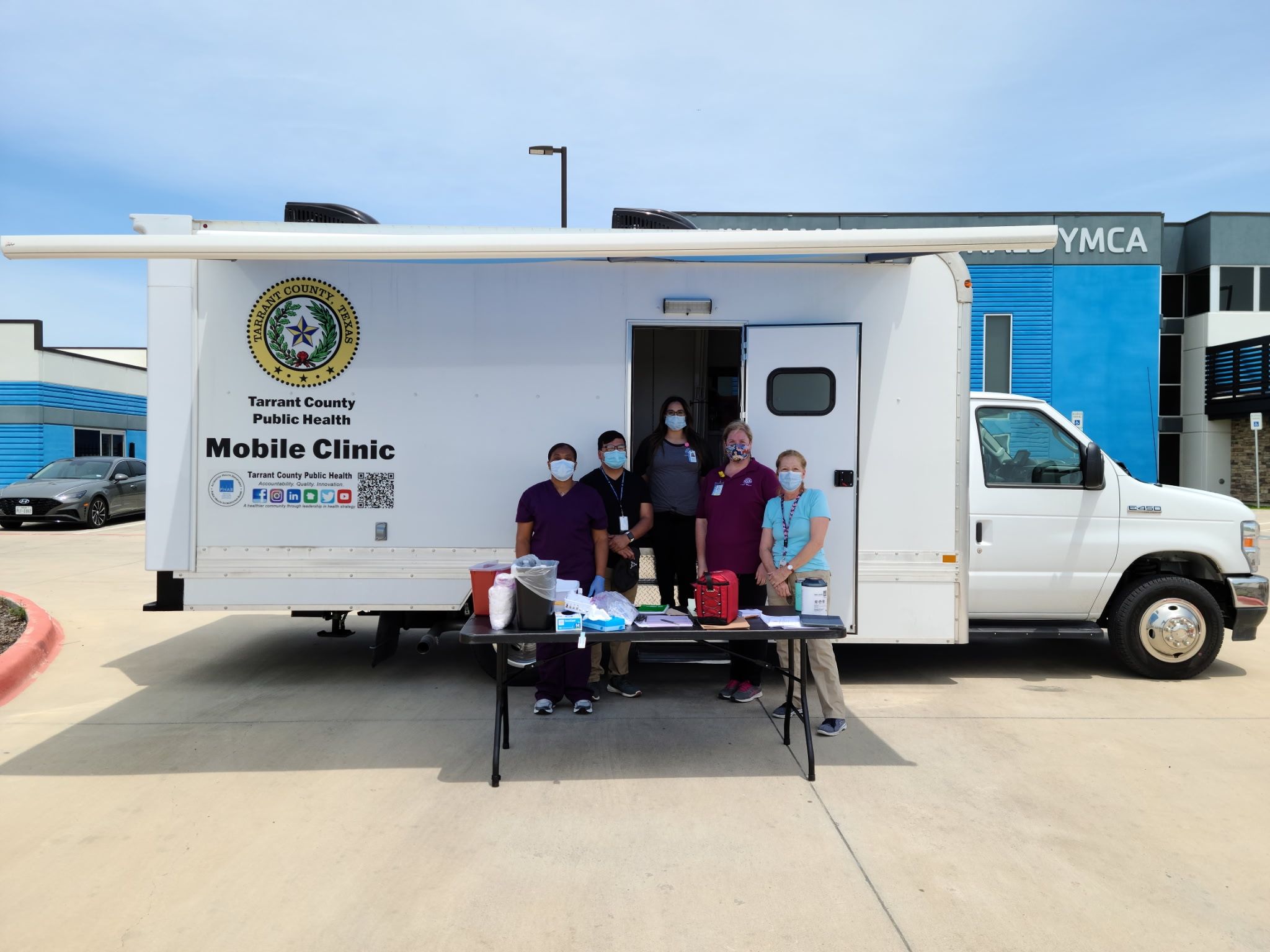
Beasley's Tarrant County Public Health Mobile Clinic (Erin Beasley)
Beasley's Tarrant County Public Health Mobile Clinic (Erin Beasley)
"We were able to travel all over Tarrant County and just randomly pop up where we saw a bunch of people — homeless shelters, schools, concerts — and give vaccines right there," Allen said. "We didn't wait for appointments. We went where the need was."
Their initiative complemented a broader county effort, the Vaxmobile, a 60-foot bus launched in early 2022 by TCPH in collaboration with Trinity Metro, aimed at reaching neighborhoods with the lowest vaccination rates. The bus made weekly stops at public libraries, churches and community centers across Fort Worth, offering walk-in COVID-19 vaccines to anyone age five and up. No insurance required. Health educators, including bilingual staff, were on board to answer questions, and the mobile clinic included a post-vaccination recovery area.
What began as a temporary solution during the pandemic evolved into a sustainable outreach model. The success of the trailer inspired other divisions to adopt similar setups for health fairs, back-to-school events and disaster response planning.
"It opened everyone's eyes to what public health could look like," Allen said. "It wasn't just people coming to us anymore. We were going to them."
Beasley views this outreach as an extension of her mission.
"Public health is about meeting people where they are," she said. The trailer exemplified her belief that prevention means removing barriers, not waiting for people to come to the system first.
According to the Centers for Disease Control and Prevention, 51.3% of Tarrant County residents were fully vaccinated against COVID-19 as of November 2021. By May 2023, that number had risen to 58.2% — a direct reflection of the effectiveness of mobile efforts such as the Vaxmobile and expanded outreach from community pop-up clinics. County officials credit these programs with helping close gaps in neighborhoods that previously had the lowest vaccination rates.
The project became a symbol of the department's adaptability. It was proof that prevention could be mobile, flexible and human. It reflected the trust inside Beasley's team.
"She never once said, 'That's too much,'" Allen said. "She just said, 'Let's figure it out.' That's Erin."

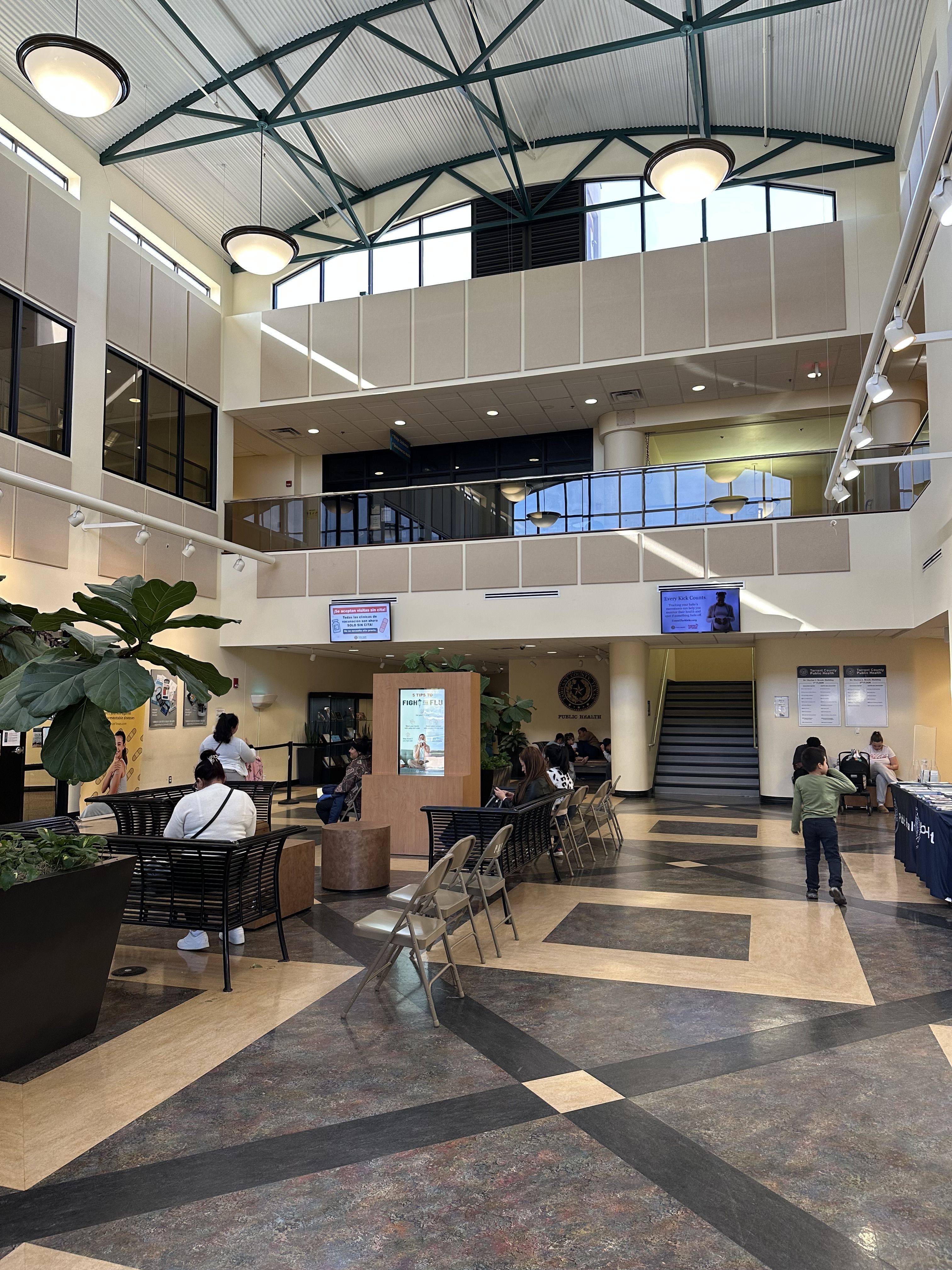
TCPH lobby at their Main Campus office (Cecilia Murphy)
TCPH lobby at their Main Campus office (Cecilia Murphy)
Community Connection
In the lobby of TCPH, people filed through for appointments, immunizations and walk-in consultations. Between soft voices, a mouse clicked as patients checked in. The atmosphere was chilly, but the smiles of families warmed the room. Among them sat Luis, a man quietly awaiting his turn in a small corner chair. With a folded piece of paper bearing the word "Influenza," he appeared uncertain.
"I'm here for my shot," he said softly. "I don't have a doctor to go to."
Luis shared his struggle to find a clinic that would accept him because he lacked health insurance. Eventually, the staff directed him to the immunization clinic, where he successfully received his flu shot for the season.
County records reveal that TCPH's immunization program is committed to not turning away anyone due to financial constraints. Through the Adult Safety Net (ASN) program, adults who are uninsured or underinsured can receive vaccines free of charge, with only a small administration fee. This access is vital in a county where approximately 16.1% of adults aged 18 to 64 are without health insurance, according to the CDC's 2022 PLACES data.
However, as Beasley points out, access is only part of the solution. Education plays a crucial role in prevention. Her division offers resources in multiple languages, alongside fact sheets and educational materials that clarify vaccine safety and scheduling.
"It's not just about giving a shot," she said. "It's about making sure people understand why they're getting it."
That is the core of prevention. It is not dramatic or urgent. It unfolds steadily and incrementally. Through ongoing conversations, education empowers individuals to recognize their health needs, understand when to seek care, and appreciate the support system available to them.
For Beasley, moments like Luis’s are the epitome of this philosophy.
When Beasley talks about prevention, she is not referring to the kind that makes headlines. She points to the kind that unfolds through organization, trust and small daily choices that create positive ripples throughout the community.
"Most people only think about public health when there's a crisis," she said. "But what we do is to make sure those crises don't happen." Although her work may be discreet, its effects run through the county every day.
 Built with Shorthand