
The status of the Stanley
How reusable water bottles have taken over the social status scene.
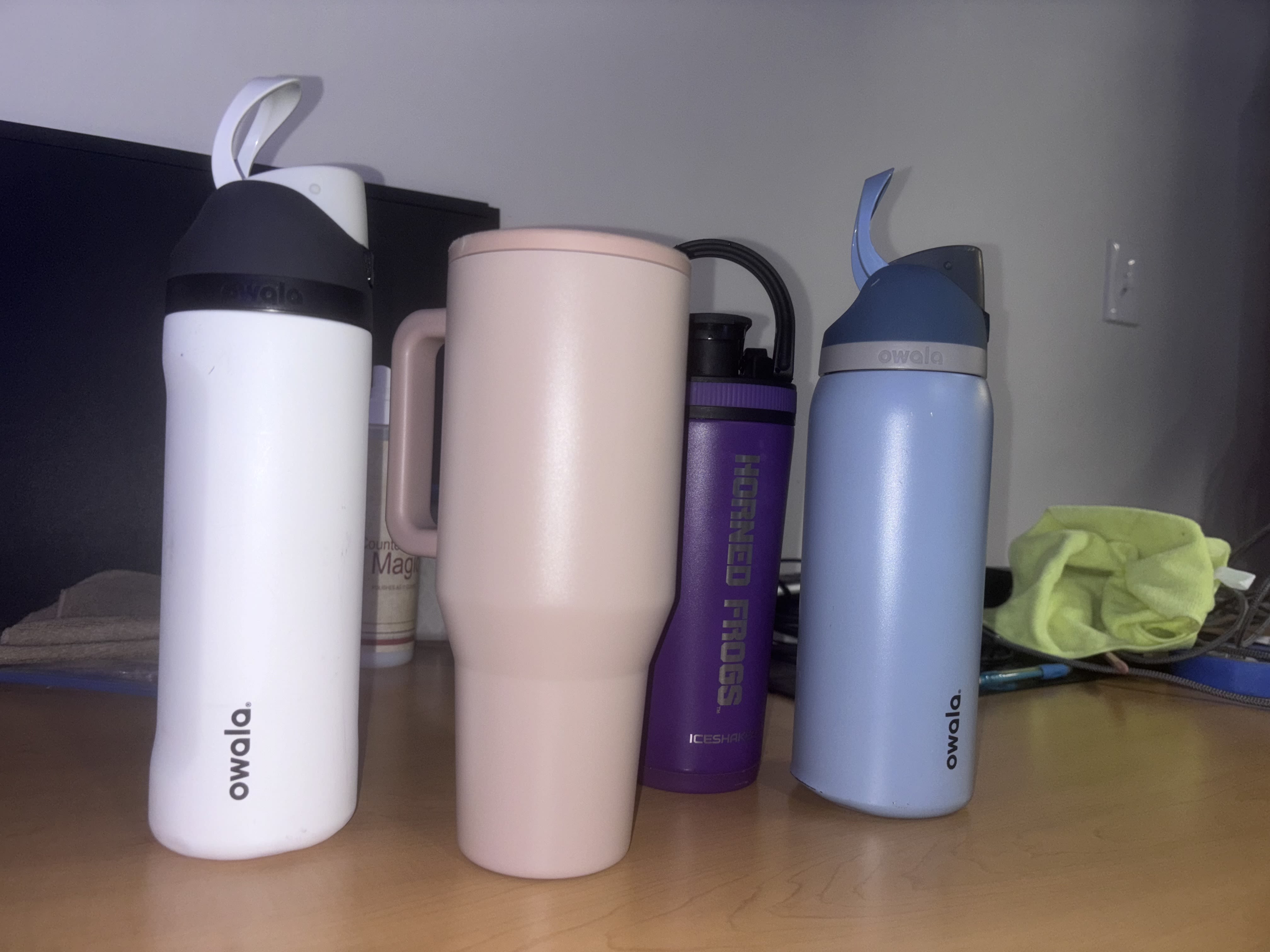

An epidemic is taking over TCU. Overconsumption is something that plagues many Americans, as purchasing the newest model of a product is at the forefront of their mind. Companies thrive off of the population’s “wants” – promoting new products that do the same thing as products that these consumers already own. This prompts many individuals to stock up on certain items, building a library of “stuff” in their cabinets and closets.
TCU students align with these patterns seamlessly. Many students pay attention to trends and fads, and they do whatever they can to keep up with the times. One product that sticks out as a perpetrator of this consumption trend is reusable water bottles.
The function of this product model is simple. It’s aimed to reduce plastic waste, as the product is often a metal bottle that can be cleaned, allowing people to refill their water and prevent disposable bottle counts from piling up. It seems simple enough, but nothing is ever as simple as it seems.
Reusable water bottles have had a recent boom in popularity. It seems new brands emerge weekly, new styles emerge daily and a new influencer is promoting a style every hour. This recent popularity has sparked a phenomena that has plagued TCU students, as seemingly every student carries a reusable water bottle with them around campus. Each brand and style carries with it their own social stigmas and subconsciously communicates information about their status to other people who see them.
According to a study from Case Western Reserve University, the market for reusable water bottles is estimated to grow over a billion dollars in the next eight years.

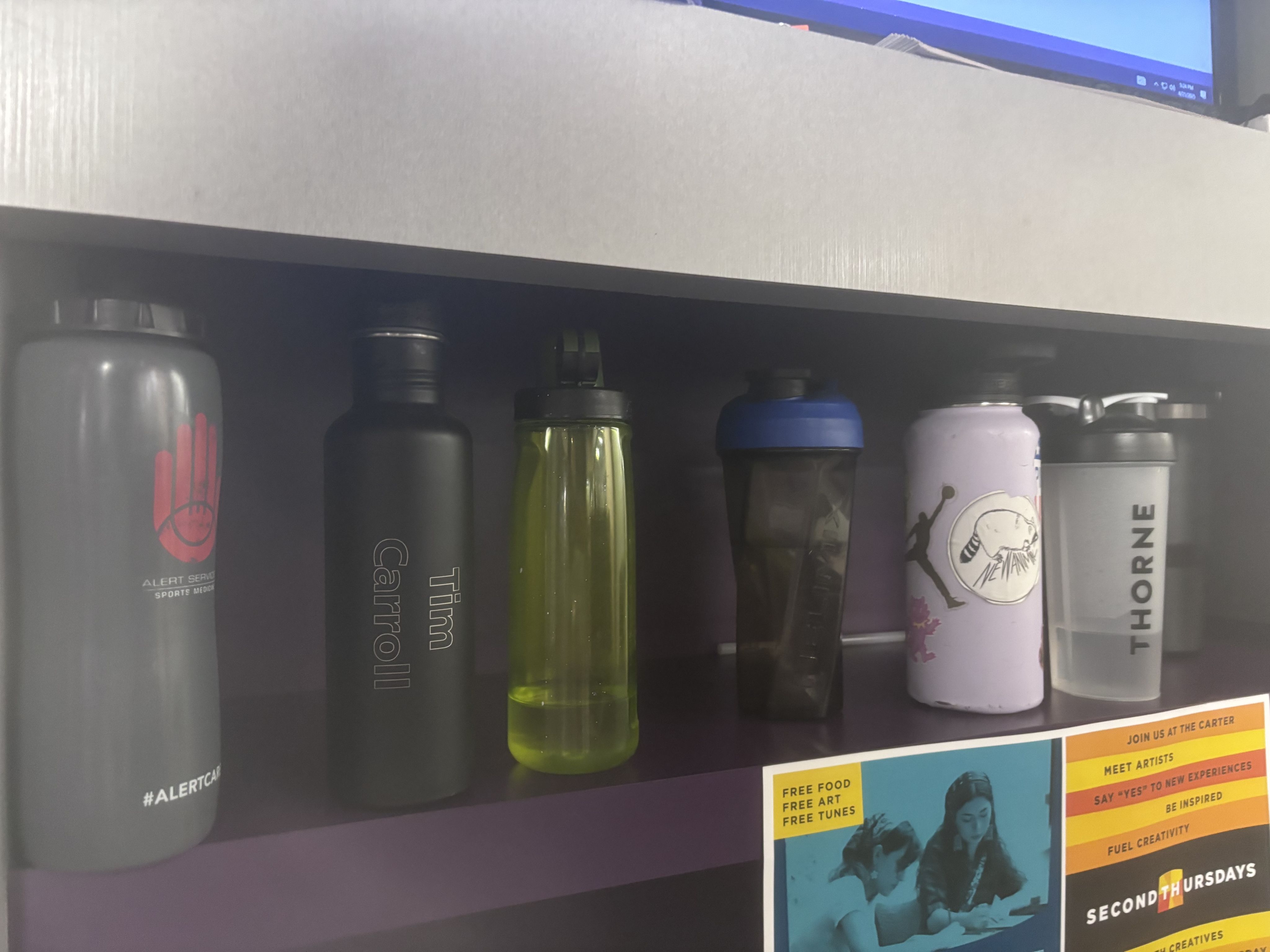
The lost and found section on the third floor of the Moudy South building on TCU's campus. Seven different water bottles were left behind - each of them different brands. (Ryan Thorpe / TCU360)
The lost and found section on the third floor of the Moudy South building on TCU's campus. Seven different water bottles were left behind - each of them different brands. (Ryan Thorpe / TCU360)
@makaylaamarie participates in a "Battle of the Tumblers" review on TikTok. Showcasing the good and bad of each cup, she describes her opinions and thoughts -- leaving both good and bad reviews to influence her audience.
@makaylaamarie participates in a "Battle of the Tumblers" review on TikTok. Showcasing the good and bad of each cup, she describes her opinions and thoughts -- leaving both good and bad reviews to influence her audience.
“They can be reflective of trends,” said senior philosophy and political science double major Vivian Blakeley. “This can kind of signal that you’re in an in-crowd, especially with the Stanley Cup after everyone had them overnight when it blew up on social media”
Blakeley owns three reusable water bottles.
@holleygabrielle on TikTok shares her new HydroJug sleeve collection. HydroJug is not one of the most popular reusable water bottle brands, but has rising stock due to collaborations and influencers.
@holleygabrielle on TikTok shares her new HydroJug sleeve collection. HydroJug is not one of the most popular reusable water bottle brands, but has rising stock due to collaborations and influencers.
Social media is a powerful tool. Many TCU students find themselves using multiple social media platforms on a daily basis. This leaves room for influencers to thrive, trends to take a strong hold on students’ minds and for celebrities to make their mark on different industries. Each of these different methods prove to be a breeding ground for reusable water bottle consumption among TCU students.
“The influencers and the brands are doing a really good job of promoting to the crowd that they want to appeal to,” said sophomore biology major Drew Lehman.
Lehman does not own a reusable water bottle.
The question is – why? Why do people see reusable water bottles as a social hierarchical product?
Dr. Amorette Hinderaker, associate professor of organizational communication and a convener of debates, conducts research on organizational theories and how businesses get individuals to identify with their products.
“Companies have a vested interest in fostering identification in such a way that there's a social contagion element to it,” Hinderaker said. “It's a young person's game, because it's the Tiktok audience. That’s how this stuff spreads.”
Hinderaker described three specific organizational theories that play into the reusable water bottle overconsumption fad.
Identification Theory
This George Cheney ethos theory describes the process and product of socially identifying with a certain organization, brand or product.
The process describes the certain steps that are taken for an individual to become identified. It’s the individual seeing the reusable water bottle in public or on social media, going to purchase the reusable water bottle and integrating the reusable water bottle into their daily life.
The product shows the efforts of the organization to create identity among its members and then seeing the results of those efforts. It’s the reusable water bottle companies putting out social media videos, having brand deals and taking other steps to allow individuals to visualize themselves with the product.
Greenwashing and Corporate Social Responsibility
This concept focuses on corporations and how they prove themselves to be responsible to consumers, which either reduces guilt or convinces consumers that they’re making a purchase to save the environment.
When reusable water bottle companies put out different brands, styles and colors – the environmental impacts from production plants creates pollution, particulate matter and other environmentally degrading impacts.
These companies, however, don’t show the dark side of production, but focus on the "green" aspects of their products.
Conspicuous Consumption
This Thorstein Veblen theory highlights the status implications mentioned earlier. This American economist wrote about specific goods that people will purchase not because they necessarily need them, but because of influence from external sources.
This includes, but is not limited to, social media, influencers, friends and other individuals you might look up to.
These reusable water bottles are consumed not to necessarily stay green, but also to prove a certain type of identity or a social belonging.
An anonymous survey of 100 TCU students of different classes and genders shows some of these results of how these theories impact real people. Of the 100 responses in the survey, 94 students stated that they owned and used a reusable water bottle on a daily basis.
The rest of the data is based on the 94 responses. When asked about the overall quantity of reusable water bottles consumed, only 16% of individuals said that they only owned one – leaving more than 80% of individuals owning multiple, with some even owning more than six.
Junior movement science major Sydney Thomas owns three reusable water bottles. She says, however, that there is an important reasoning behind each one.
“One of them is for everyday activities, like classes or being outside. Another is a shaker bottle, with a spring ball in the middle for protein shakes that I use after working out, and the other is nicer and has a straw – I use it when I’m just sitting at home,” Thomas said.
This astonishing amount of reusable water bottles owned by singular individuals stems from many reasons. Three reasons distinctly stuck out as to why students used reusable water bottles.
32% of students said that they bought their water bottles because of trends and influencers. 25% said they received their water bottle as a gift, and 24% said they bought it to reduce plastic waste and help the environment.
Two other reasons stuck out as a smaller pattern, but are still notable enough to include in the findings.
6% of students said they purchased the water bottle for travel, and another 6% said that they purchased the water bottle for convenience and practicality.
Senior graphic design major Rashaia Labrador doesn’t own a reusable water bottle. She has her thoughts, however, about how the product has impacted her friends and family.
“75 percent of people have it for trend and like the other 25% probably actually use it because they need cold water,” Labrador said. “I feel like one influencer makes something super popular, and then everyone wants that one specific thing.”
Of the different brands of reusable water bottles that TCU students consume, four of them soared as the top contenders. It’s important to note that students completing the survey were given the option to select multiple, so numbers exceeding 100% include students possessing more than one reusable water bottle. The top four were the Stanley Cup (34%), Yeti (34%), Owala (28%) and HydroFlask (27%).
Students not using any of the brands of reusable water bottles listed above were given the choice to share their own brand. In addition to all of these brands of reusable water bottles listed, 18 individual responses were given with different brands that TCU students used on a daily basis.
Lastly, the survey asked these TCU students about the social media platforms that they use most on a daily basis. Similar to the question asked above about the preferred brands, students were given the option to select multiple platforms that they use. Unsurprisingly, multiple platforms had a high amount of daily users, with the top two as Instagram (96%) and TikTok (72%)
The internet is a powerful place. Whether it’s for advertising from reusable water bottle brands, influencers sharing their thoughts on specific brands and styles of reusable water bottles or the thousands of millions of people that you can be connected to at the click of a button – false facts and divisive opinions exist everywhere.
“It’s something to be wary of,” Thomas said. “We like to trust influencers and believe that they’re reliable sources and only promote products that they genuinely enjoy, so it’s important to be cognizant of that.”
People are also extremely susceptible to social and status implications – hoping that each reusable water bottle that they buy will help them fit into the social mold constructed by social media and status.

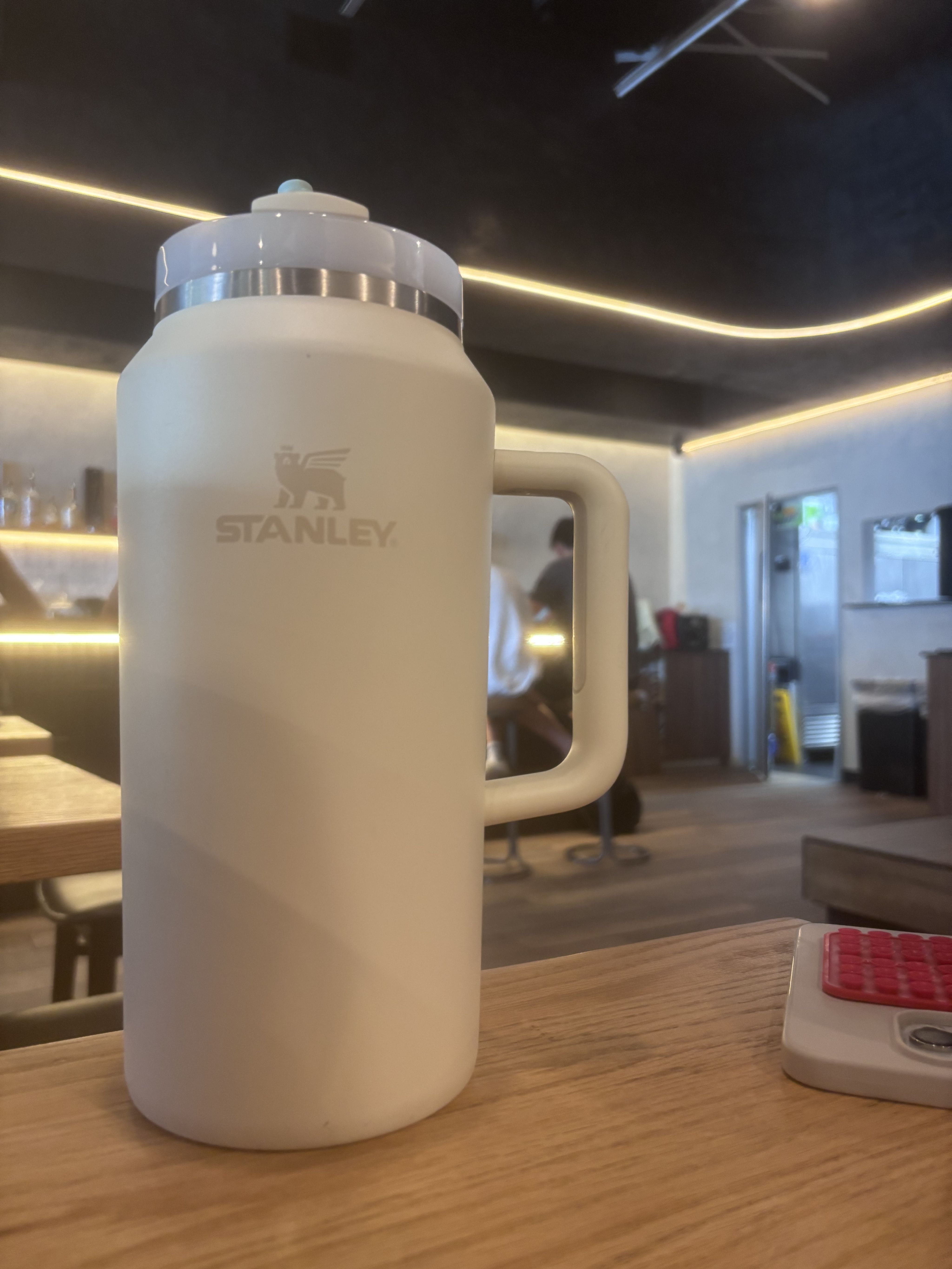
A large Stanley Cup branded reusable water bottle sitting on a table at Ampersand coffee. Stanley Cup is one of the most popular water bottle brands for TCU students. (Ryan Thorpe / TCU360)
A large Stanley Cup branded reusable water bottle sitting on a table at Ampersand coffee. Stanley Cup is one of the most popular water bottle brands for TCU students. (Ryan Thorpe / TCU360)
Looking at things like native clicks – and seeing where individuals come from when purchasing reusable water bottles online, demographics of purchasing and the history of production from each brand are the next steps in continuing this research.
“I just encourage people to really think critically about the things they're consuming and ask yourself why you're buying the things you're buying,” Hinderaker said.
 Built with Shorthand