
The NIL Landscape
Is TCU just a small fish in a large ocean?

May 11, 2020, was one of the biggest days in the history of TCU recruiting.
North Shore running back Zach Evans became the first official five-star recruit (per 247Sports.com) in the history of the TCU football program.
Following two seasons and 1,063 rushing yards in a purple and white uniform, Evans announced on Jan. 6, 2022, that he would be committing to Ole Miss via the transfer portal
Just six months prior to his decision, the NCAA passed a bill allowing student athletes around the country to receive monetary compensation for their Name, Image, and Likeness (NIL).
Evans’ departure was speculated to be because of a large NIL deal in Oxford, and even his new head coach, Lane Kiffin, recognized the jungle that is the NIL world in a press conference last season.
“I mean, we have free agency in college football, and the kids, a lot of times, go to where they get paid the most,” Kiffin said.
If one puts the Evans situation in a vacuum, the outlook of TCU’s ability to compete with bigger, richer schools for recruits or even to keep current talent in the future is grim.
When comparing TCU and Ole Miss, it’s hardly apples to apples. TCU has just under 10,000 undergraduate students per year and around 90,000 living alumni, while Ole Miss is right under 17,000 undergraduates and over 120,000 living alumni.
Ole Miss also competes in the SEC, which generated $729 million during the 2020-2021 athletics season compared to the $409.2 million of TCU’s Big 12.
What occurred with Evans is not the norm, though, and while the Frogs appear to be small fish in a gigantic pond of NIL, TCU Athletics believes they have the approach and the partnerships to keep up with the bigger fish.
“Take any SEC school that’s public: they probably have more available NIL resources just because of the size of their alumni base,” TCU Athletic Director Jeremiah Donati said. “At some point, it becomes a math problem, so we’ve got to find other strategic ways.”
TCU star RB Zach Evans plans to enter transfer portal
— NIL Newsstand (@NILNewsstand) November 30, 2021
Sources indicate name, image and likeness will play a big role in picking Evans' next destination. https://t.co/8B5NcmtFv6 @chris_hummer #NIL
@MikeMilesJr_ has partnered with PSD Underwear..
— Mickey Miles (@msmickey3) September 19, 2021
All God’s timing🙏🏾 pic.twitter.com/JvGfOzNBDX
Late to the party
NIL deals were officially permitted to be placed on July 1, 2021, and though TCU had seen the wave coming from miles away, they were not quite ready for its impact.
TCU Associate Athletics Director for Development Michael Levy said that TCU had a plan already in place when NIL was passed but that it became “a more frequent conversation” for fans earlier than they imagined.
Because of that, Levy and others within TCU Athletics said that donors and local businesses were hesitant to give before they fully understand what NIL entailed.
“TCU has never been the first one to the party, but we eventually show up in a pretty big way,” Levy said. “I think we’re finding that out in NIL. We have a lot of really resourceful, successful donors, but they don’t blindly throw their money at things.”
As the second-smallest school out of all Power 5 teams (larger than only Wake Forest), TCU already had a disadvantage when it came to raising money as a school and as an athletic program prior to the passing of NIL.
Now, though TCU is prohibited from giving money straight to athletes or even facilitating deals, they are forced to ask for the same donors and alumni to give to the external sources that can help compensate athletes.
On top of that, when it comes to utilizing NIL in the area of recruiting, Donati believes that time could wear the pockets of givers thin.
“I think you’re going to find that donors are going to get tired of spending crazy money on recruits who won’t be there, that’ll transfer, won’t pan out,” Donati said.
In the eyes of Donati, though, an advantage that TCU has is being in the Dallas/Fort Worth metroplex—a much bigger market than most schools of which the Frogs compete.
“One of the things is we’re going to have to utilize our market. By that market, I mean DFW,” Donati said. “While we have 90,000 living alums, there’s a lot of local businesses that I think would get involved.”
Some businesses already have stepped up, and while most of the deals that TCU athletes sign are not posted publicly, Donati said that there have already been “hundreds of deals” for Horned Frogs.
What truly got the ball rolling for TCU’s NIL efforts, though, was a pair of TCU alumni who wanted to get the Horned Frogs on the right track and created an NIL collective that has since raised millions of dollars for student athletes.
The Flying T Club
Ches Williams (’92) and Jeff Patman (’00) both graduated from TCU over 20 years ago, but when they realized they good use their connections to benefit the Horned Frogs in the NIL world, they took action.
Once deals started to break news around the country, Patman reached out to former TCU head coach Gary Patterson about putting a group together to raise money for NIL, and Patterson immediately got on board as the Frogs’ football season got started.
Soon after, Patman and Williams got eight of their friends to join them in starting a fund that would become what is now know as the Flying T Club.
Over the next few months, the club began sponsoring athletes, using organized parties to raise awareness about the collective and fulfill the athletes’ requirements for earning their compensation.
While the other main TCU NIL Collective, Think NIL, has focus on getting corporate support for TCU athletes, the Flying T Club is simply focused on connecting with donors.
“We want to be the storefront for the individual fan, individual donor that wants to support TCU student athletes at literally any level,” Williams said.
The Flying T Club now has three levels of membership (Silver, Gold, and Platinum) that allows for donors to give money for the collective to disperse to athletes.
Going forward, the collective plans to have four events a year—two in Dallas and two in Fort Worth.
As of now, the club gives monthly compensation to select athletes of their choosing from TCU football, men’s basketball, baseball and beach volleyball, and their goal is to eventually be able to pay every scholarship athlete from the revenue sports (football, men’s basketball, baseball).
“Part of what we quickly realized is that when you start telling everybody, ‘Hey, I’ve got Quentin Johnston. I’ve got Mike Miles. I’ve got Emanuel Miller. I’ve got Big Eddie [Lampkin] coming to these events with the coaches, and you guys get to actually mingle with them, learn about them, get to know them and get some insights,’” Williams said. “People are all over that.”
The Flying T Club is not officially associated with TCU, but they work with TCU compliance to make sure their compensation for athletes occurs in a fair, legal manner.
According to Donati, Levy and others within TCU Athletics, the club has been helpful in TCU’s NIL efforts.
“So badly do they [donors] want to just say, ‘Here TCU, here’s the money. Divide it up amongst your sports as you best see fit,’ like we do now for fundraising,” Levy said. “We can’t do that, so where these collectives are helpful is that they can put the dots together for donors.”
Several sponsored athletes have echoed similar appreciation for the Flying T Club.
“It’s [Flying T] been awesome. What they’ve done for the program is really cool,” TCU quarterback Chandler Morris said. “We had an event last night actually. They’re taking care of us. They treat us like family.”
A quote from a TCU student athlete at the Flying T Club event on Wednesday:
— Colin Post (@colinp_3) April 15, 2022
“I send some of my money to my mom to help with her bills. She has two jobs and never missed my games…I just want to help keep the electricity on back home while I can help.”
This is why NIL matters.
Again thankful to the Flying T Club for hosting this wonderful event @CoachSonnyDykes @Chandleram4 Quentin Johnston, TreVius Hodges-Tomlinson and Kendre Miller #FrogsToday #GoFrogs @roxomediahouse pic.twitter.com/B8QYl9H3Wk
— Frogs Today (@frogstoday) March 23, 2022

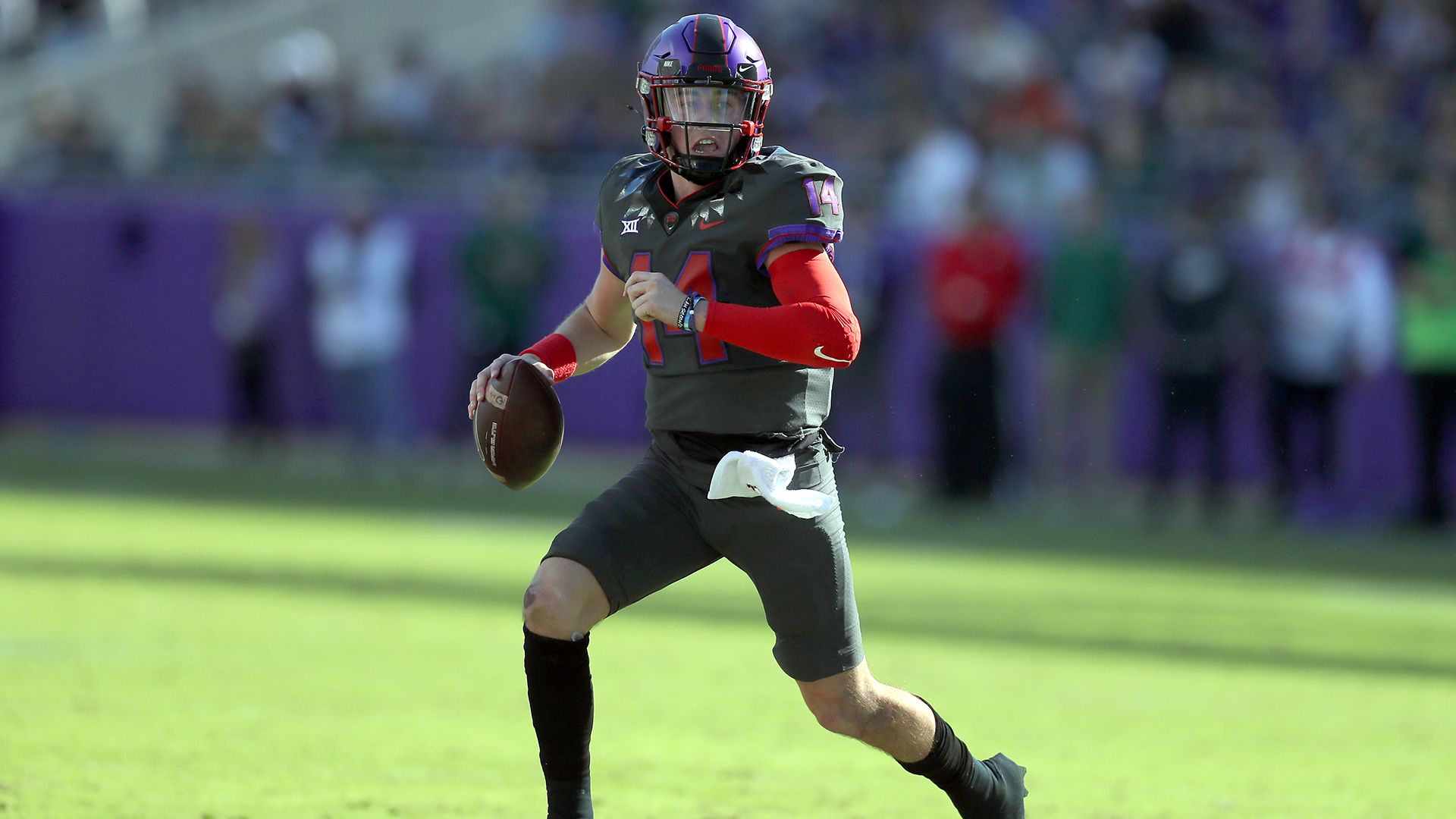
TCU quarterback Chandler Morris (14) is competing for the starting job under center for the Frogs, and he's also one of the football players sponsored by the Flying T Club. Photo courtesy of gofrogs.com)
TCU quarterback Chandler Morris (14) is competing for the starting job under center for the Frogs, and he's also one of the football players sponsored by the Flying T Club. Photo courtesy of gofrogs.com)
Treading water
As the college sports world approaches the first anniversary of NIL, TCU has what they need in place to keep their head above water.
Through business deals in the area and collectives like the Flying T Club, Horned Frog student athletes have seemingly received compensation on par with the majority of Power 5 schools.
“Our numbers are competitive from conversations across the board I’ve had with over Athletic Directors,” Donati said.
Donati’s claim is hard to prove, though, as the NCAA has failed to keep schools accountable to publicly revealing the deals that their athletes are receiving.
What’s more, TCU’s lack of a large alumni base raises questions as to how long they can keep up the push they are currently making.
“The model in the sense of basically having donors bail out student athletes and kind of prop up the money every single year is a little worrisome,” Levy said. “I feel like finding more collective wide deals where we can find legitimate sponsorships for these student athletes will kind of be our next step.”
Over the offseason, TCU’s ability or inability to keep their big time athletes on their campus and draw big names in will be the thermostat by which their NIL efforts will be gaged.
Until then, the Horned Frogs remain a small fish in the large, shark-infested ocean that is the NIL landscape.
 Built with Shorthand