Punching Out Parkinson's
Fighting Back Against PD One Round At A Time
The thud of heavy bags echoes across the gym as the guitar notes of Free Bird by Lynyrd Skynyrd play through the speakers.
“Right hook! Duck! Double jab! Block low!”
“WHAAMMMM! Wham, wham, WHAM!”
In the center of the ring, boxing gloves snap against the leather pads as combinations are called out.
In one corner of the room, participants roll their fists across a speed bag in a steady rhythm, the rapid patter echoing like a drumbeat.
“Whap-whap-whap, whap-whap-whap, whap-whap-whap.”
In another corner, someone ducks and weaves beneath a swinging slip bag.
Large fans buzz, jump ropes slap the ground, and every sound in the room blends into a constant rhythm of movement.
On the wall, a painted sign reads, “Never Ever Give Up. One Round at a Time – Punching Out Parkinson’s,” with photos of boxers lining the space around it.
The room smells of old leather and sweat-soaked canvas as everyone pushes themselves to their limit until the round-ending buzzer cuts through the noise.
Each person in the gym carries a different story, but they all share the same fight beyond the workout – pushing back against Parkinson’s Disease.
What is Parkinson's Disease?
Parkinson’s Disease (PD) is a progressive neurodegenerative disorder that primarily affects movement, caused by the gradual loss of dopamine- producing neurons in a region of the brain known as the substantia nigra. As dopamine levels decline, patients experience various symptoms, which include but are not limited to: tremors, muscle stiffness, slowed movement, and difficulty with balance and coordination. While it most commonly develops later in life, Parkinson’s affects every individual differently, with symptoms and progression varying from person to person.
Since its first documented case in 1817, a cure for Parkinson's Disease has remained unfound. From immunotherapy to surgical treatments, gene therapy to stem cell replacement, researchers have spent decades searching for a breakthrough that can stop or reverse the disease’s relentless progression. Most treatments for PD focus on managing symptoms and maintaining quality of life rather than stopping the disease altogether.
Many high-profile figures have brought increased awareness to the disease through their diagnoses, including legendary boxer Muhammad Ali, actor and advocate Michael J. Fox, and singer-songwriter Neil Diamond, helping to shine a public spotlight on Parkinson’s and its impact.
Parkinson’s Disease is commonly categorized into different forms, with Idiopathic PD being the most prevalent. Within this form, symptoms are typically divided into two major categories: motor symptoms, which affect movement and physical control, and nonmotor symptoms, which impact areas such as mood, cognition, and autonomic function.
Idiopathic Parkinson’s Disease: Motor and Non Motor Symptoms
Motor (Movement) Symptoms
- Shaking (tremors)
- Slowness of movement
- Rigidity (stiffness)
- Loss of balance
- Motor symptoms tend to start out mild and worsen over time
Non-Motor Symptoms
- Mood disorders like depression, anxiety, and loss of motivation
- Sleep disorders
- Fatigue
- Loss of sense of smell
- Reduced cognitive function
Exercise into Action
In the absence of a cure, attention has increasingly shifted toward ways to help patients maintain control over their bodies and independence for as long as possible, with one method standing out for its simplicity and real impact: exercise.
At the University of Hard Knocks gym in Fort Worth, Texas, former two-time world champion boxer Paulie Ayala has turned the idea of exercise into something amazing. In 2011, he launched Punching Out Parkinson’s (POP), a non-contact boxing-based training program designed to help individuals with Parkinson’s improve strength, coordination, balance, and confidence in ways that traditional treatments often cannot.
Most participants in the POP program are diagnosed with Idiopathic PD, aligning with the most common form of the condition.
The POP program operates as an extension of Ayala’s gym, which otherwise functions as a traditional boxing facility offering classes for a range of ages and skill levels.
“I always wanted a way to give back to the city of Fort Worth,” said Ayala. “This was something I felt in my heart to do – to take what I know and use it to help people fight back.”
The Beginning
But Punching Out Parkinson’s didn’t begin as a formal program.
It all began back in 2010, when a woman walked into the University of Hard Knocks gym looking to take boxing lessons with Ayala.
The lady, Stacey Christopher, had been living with Parkinson’s for several years and was searching for something that could help her stay active and in control of her body.
Traditional exercise options felt limited, and the boxing-based programs she had heard about were not available locally.
When she walked into the gym, Christopher was not looking to start a movement. She was looking for help.
After speaking with her and learning more about the disease, Ayala agreed to try something different. Drawing from his experience as a professional boxer, he began adapting his training style to fit her needs, focusing not just on physical movement but on coordination, reaction, and mental engagement.
Paulie didn’t set out to start an entire program, but eventually he found himself building something far bigger than he had ever imagined.
“I had been pretty involved in my church for a while at the time and felt I could be doing more in my community,” said Ayala. “Stacey walking in that day felt like a sign that this was something I was meant to do.”
Word began to spread through local support groups and neurologists who recommended the program to PD patients, and more individuals with Parkinson’s began showing up at the gym, each looking for the same thing Christopher had been searching for – a way to fight back.
“Stacey’s neurologist started telling more patients about the boxing lessons, and after that it took off,” said Ayala.


An Evidence-Based Program
As participation increased, so did interest from the medical community.
Dr. Michael Salvatore and Dr. Vicki Nejtek, along with their research team at the University of North Texas Health (UNT Health), began working with Punching Out Parkinson’s with a shared goal: to better understand how exercise could impact the progression of Parkinson’s Disease.
That connection, however, had been years in the making.
According to Dr. Nejtek, Dr. Salvatore was first introduced to the program in 2016, shortly after relocating to Fort Worth to continue his Parkinson’s research. At the time, his work focused primarily on animal models, studying how exercise could affect motor function and brain activity.
During a Punching Out Parkinson’s fundraiser that year, he met members of the boxing class community and was introduced to Paulie Ayala. Two years later, he returned as a guest speaker at another fundraiser, this time with a clearer vision of how the program could fit into his research.
“I was looking for a way to connect what we were seeing in the lab with real people,” said Dr. Salvatore. “Punching Out Parkinson’s was already doing something meaningful – people kept coming back – so the question became, how do we measure that?”
That question ultimately led to a collaborative research effort beginning in 2018, with findings published in 2022.
In their UNT Health study, Dr. Salvatore, Dr. Nejtek and their team tracked over 40 Punching Out Parkinson’s participants engaged in non-contact boxing workouts and found that the training consistently elevated heart rates to moderate intensity levels, a range considered both safe and effective for individuals in the early stages of PD.
Rather than requiring extreme or high-intensity exercise, their research showed that consistent, moderate activity was enough to produce meaningful results.
Those who took part in the program also showed measurable improvements in mobility and cognitive performance compared to those who did not exercise. Parallel testing in laboratory rat models reinforced the idea that this level of aerobic activity can play a meaningful role in slowing motor decline, helping bridge the gap between controlled scientific research and real-world application.
“In our pilot, preliminary studies, we found that patients with PD who participate in at least three months of aerobic exercise where their heart rate increases at least 35% above resting levels, and when they participate at least three times a week, have significantly better cognitive flexibility on standardized tests than those patients who do not exercise regularly or those who do not meet the metrics I just described,” said Dr. Nejtek.
While the physical benefits for POP participants are measurable through research, the program’s impact extends beyond clinical data.
“Motivation to participate regularly is significantly increased with the social aspect of like-minded people who are facing the same struggles,” said Dr. Nejtek. “There is a certain camaraderie within the group – it is a community banding together for the common good of everyone who participates. They lift each other in ways no one else can fully appreciate.”
That feeling of connection is a central part of what keeps participants coming back.
Class Structure
Fast forward to today, and participants file into the gym weekly, greeting one another with familiar smiles, laughter, and a feeling of camaraderie as they prepare for class.
Each Punching Out Parkinson’s class follows a structured routine designed to challenge both the body and mind.
Led by Paulie and his son, Paul Jr., sessions begin with a 10 to 15-minute warm-up focused on stretching and mobility, preparing participants for the movements ahead.
Everyone gathers around the ring in the center of the gym, moving together from stretch to stretch. The laughter and easy conversation don’t disappear, but they settle into the background as the tone of the room shifts.
It’s as if, in that moment, they flip a switch, stepping into the mindset needed to take on the workout ahead.
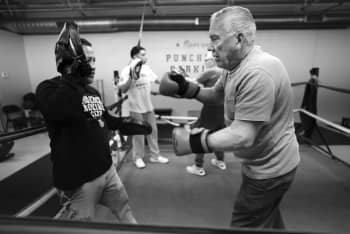
After the warmup, the group rotates through a series of stations, spending roughly 30 minutes in groups of one or two. Each station presents a different workout – working the speed bag, aiming to pinpoint a rhythm, slipping and dodging the swinging bag, driving punches into the heavy bag, and finally, the fan favorite – trainer-led mitt work with either Paulie or Paul Jr. that takes place inside the ring.
“I feel like most participants’ favorite part of each session is the in-ring work that we do,” said Paul Jr. “I love seeing their faces light up after landing a successful combination and getting to watch their confidence grow.”
“I’m always encouraging them as if it was a real boxing match,” said Paulie. “I’ll clinch with them, joke around, tell them that if it was a real fight they’d be losing – just to keep it fun and keep them engaged. It makes them react, move, and stay in the moment like it’s a real fight.”
After the first circuit, the class moves on to light resistance training and a cooldown.
Participants take on exercises including the rowing machine, weighted lunges, jump rope, resistance bands, and passing an exercise ball back and forth.
Paulie and Paul Jr. move throughout the room, offering guidance, adjusting form, and stepping in to encourage participants through each movement.
“Everyone comes in wanting to get better every class,” said Paul Jr. “They’re focused. They want to learn, they want to improve, and after a while you don’t even have to say much – they start reacting on their own, especially in the ring.”
The class closes after an hour.
Participants, now tired from pushing themselves as hard as they could, begin to say their goodbyes before heading home for the night.
For most, POP is more than a class – it’s become a community and an outlet for them each and every week.
Hear from the Participants
Steve P. is a perfect example of the impact POP has had on all participants involved.
A healthcare executive who has spent his entire professional career in medicine, Steve was diagnosed with Parkinson’s Disease in 2017 after initially fearing he may have ALS, also known as Lou Gehrig’s disease.
“I was relieved that I didn’t have ALS, but obviously really concerned that I did have Parkinson’s,” said Steve. “My wife and I decided we needed to do everything we could to understand the disease and figure out what steps I could take to manage it moving forward.”
Shortly after his diagnosis, his neurologist recommended Punching Out Parkinson’s as a way to stay active and slow the progression of his symptoms.
“The more I learned about Parkinson’s Disease, the more I realized that exercise is medicine,” said Steve.
When he first arrived at the gym in 2018, Steve sat off to the side and watched a class before joining in.
He remembers seeing participants at all different stages of the disease, some struggling through movements while others moved confidently through the stations.
Still, something about the class immediately stood out to him.
“The thing I need to say about Paulie is that he’s literally a world champion, but he’s got a heart for Parkinson’s that’s amazing. He’s patient, supportive, and it’s clear that he’s genuinely invested in helping people here,” said Steve.
Although Steve had previously completed 17 marathons before his diagnosis, boxing was entirely new to him. But over time, the combination of physical challenge and working out with other PD patients kept him coming back.
“The thing about Parkinson’s is there’s a tendency to feel isolated and alone,” said Steve. “When you find people who are walking in those same shoes, there’s an instant sense of community. You compare symptoms, medications, struggles – but more than anything, you realize you’re not going through it alone.”
Now, after more than eight years with the program, Steve says the workouts have helped him maintain both his independence and confidence despite living with a progressive disease.
“If you asked my kids, they’d tell you I look and act younger than I did before I started,” said Steve. “Before this, I was moving slower and becoming increasingly limited. Now I feel stronger, more comfortable, and like I still have some control instead of just being carried along by the disease.”
As for Tito Espinosa, the program became part of a much larger effort to maintain the independence and lifestyle he had built over a lifetime of movement and problem-solving.
Born and raised in Colombia before eventually settling in Fort Worth, Espinosa spent decades working as an aerospace engineer on projects ranging from commercial aircraft to military programs.
About five years ago, however, he began noticing subtle physical changes that were harder to explain away.
During a routine neurological visit, his doctor noticed that Espinosa had started slightly dragging his feet while walking. At the time, the symptoms were still mild, but the concern eventually led to further testing and an official Parkinson’s diagnosis.
“The following year it became evident,” said Espinosa. “I didn’t really know much about Parkinson’s other than hearing about people like Michael J. Fox or Muhammad Ali, so it was all very new to me.”
Not long after his diagnosis, Espinosa came across information about Punching Out Parkinson’s through his neurologist and joined the program in 2019.
Like many participants, he initially viewed the boxing classes as another way to stay active. Over time, however, the workouts became something far more important.
“It got me going in the sense of, ‘Well, I’ve got to do it. I can’t delay it,” said Espinosa.
Espinosa quickly became part of the core evening class group, where participants rotate through stations together and build close relationships through the shared experience of living with Parkinson’s Disease.
For him, one of the most meaningful parts of the program has been the relationship he developed with Ayala.
“He has always been there,” said Espinosa. “Questions asked, questions answered. He’s been really influential in helping not just me, but everybody here.”
While the workouts challenge participants physically, Espinosa says the classes have also helped improve symptoms beyond simple movement and coordination.
“Balance has been a big thing for me,” said Espinosa. “But even talking has improved. Before, I used to ramble really fast. Now I’m steadier. I know what I want to say in my mind, and this program has helped me slow down and communicate better.”
Though some exercises still frustrate him, particularly the heavy bag that barely moves no matter how hard he punches, Espinosa says the in-ring mitt work with Paulie remains his favorite part of every class.
“It feels good getting in the ring,” he said. “You’re moving, reacting, thinking. It keeps you going.”
For Espinosa, “fighting back” against Parkinson’s means continuing to do the everyday things many people take for granted.
“The fact that I can still walk, talk, and do things on my own means everything,” said Espinosa. “That’s what fighting back looks like for me.”
And for Mike Warren, the hour-long classes are part of a much larger adjustment. A 67-year-old former juvenile probation officer, Warren spent nearly four decades working in Tarrant County Juvenile Services before a Parkinson’s diagnosis in 2020 forced him to rethink how he would stay active and maintain his sense of routine. A lifelong ice hockey player, Warren began noticing subtle changes on the ice long before he had a diagnosis to explain them.
What he once recognized as small physical changes, like lower movement while skating, declining balance, and a small loss of control over the left side of his body, eventually became impossible to ignore.
“I played hockey with guys much younger than me so it was easy to just attribute my slowness to my age," said Warren. “But after a while I wasn’t getting the same push off of my left side that I used to and it was getting harder and harder to keep up. You could simply touch me and I’d fall over.”
After receiving his official PD diagnosis, Warren spent the first six months adjusting to a reality that could not be changed or traced back to anything he had done. He describes that period as extremely difficult, not because of any single moment, but because of the process of coming to terms with the disease itself.
“I took the news pretty hard at first. But eventually you have to accept the fact that it's not something you caused or could control,” said Warren. “It just happens. I still don’t know why, but eventually I had to decide I was going to do what I could with it.”
Unfortunately, he was forced to give up his lifelong ice hockey hobby last October.
That acceptance eventually shifted his mindset toward action and movement, something he had already spent much of his life prioritizing as a hockey player.
Warren doesn’t recall if he or his wife found the POP program, but regardless, he took it to his neurologist, who approved it as a way to stay active and manage the disease on top of his normal medications.
He joined the program in 2021. From the jump, Warren knew he was a great fit.
“Even though I’d never boxed, I've always been a competitive person,” he said. “It’s challenging but I love that I can push myself and make it as intense as I please.”
Over time, the shared experiences between POP participants have created a sense of connection that extends beyond the workout itself, turning the class into a place where participants support one another through the challenges of Parkinson's.
That environment, Warren says, starts at the top with Paulie and the foundation he has built within the gym.
“I’m really appreciative of what Paulie has built,” said Warren. “It wasn’t something he set out to do, but he saw a need and followed it. He’s taken what he knows from boxing and turned it into something that really benefits people with Parkinson’s. It doesn’t stop the disease, but it helps slow it down, and that makes a real difference.”
One of the mottos at the POP program is, “Fighting back against Parkinson's one round at a time.”
But Warren looks at the saying a bit differently.
“I don’t really like to think of it as ‘fighting back’ against Parkinson’s when I’m at boxing class. Instead, for me, it’s a way to keep the competitive nature I’ve always had while pushing myself and getting better with the people around me.”
Steve, Tito, and Mike are a testament to how Paulie Ayala hasn’t just built a program inside his University of Hard Knocks gym, but a community.
A community that gets people excited to come back each week, where they do their best to fight back against a disease that has no cure.
Because Parkinson’s Disease is progressive and continues to worsen over time, participants are eventually forced to step away from the program as their symptoms advance and daily movement becomes too difficult.
Even so, the time they spend in Paulie Ayala’s program becomes something they carry with them long after they leave the gym, as the camaraderie and community continue to shape how they manage life with the disease.
“Coming from someone who didn’t take the traditional school path, I’ve always had to learn by doing. When I started this, I saw it as a challenge to prove to myself that I could build something meaningful from nothing. There was no blueprint for this. It was ground zero. Now, looking at what it has become, it’s more than something I started. It’s something that grew because people believed in it and continued to show up,” said Ayala.
At the University of Hard Knocks gym, Punching Out Parkinson’s classes are held throughout the week at various times for participants of all ages and abilities.
To learn more, please visit punchingoutparkinsons.org.
 Built with Shorthand