
The show must go on
Theatre TCU adapts to change as Ed Landreth is underway
On any given afternoon, Ed Landreth Hall hums with energy.
Students rehearse lines, designers sketch sets and singers warm up their voices behind closed doors.
This summer, the sounds of construction have been heard as Ed Landreth Hall gets its first full renovation.
“The building hasn’t received a major renovation since its construction,” Assistant Vice Chancellor for Planning, Design and Construction Jason Soileau said. “Given the extensive and disruptive nature of system replacements and code upgrades, it is the opportune moment to modernize the facility.”
Taking the home of TCU’s theatre and music departments offline for two years requires more than just hiring construction crews. Classes, production and rehearsals all need a space to go on.
“We have to keep producing or we won’t have students,” said Alan Shorter, a professor and musical theatre area head. “You can’t stop for two years. It’s a huge part of how we train.”
While the logistics are complex, those closest to the program say the heart of Theatre TCU won’t be left behind.
Seniors pose in front of Ed Landreth, reflecting on their time in the building before its two year renovation. (Photo courtesy of TCU Alpha Psi Omega)
Seniors pose in front of Ed Landreth, reflecting on their time in the building before its two year renovation. (Photo courtesy of TCU Alpha Psi Omega)
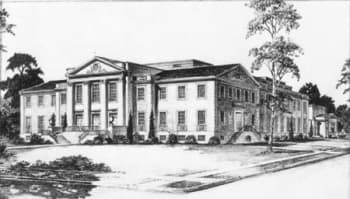
The renovation of Ed Landreth Hall, originally constructed in 1948, is expected to conclude in time for the fall 2028 semester.
The project will modernize outdated systems, address accessibility requirements and create facilities that better support today’s theatre and music programs, said Soileau.
The renovation will include new performance spaces, updated classrooms and expanded resources designed to match current industry standards. But reaching that future requires a temporary reality: moving everything and everyone out.
To make the renovation possible, Theatre TCU has relocated across multiple sites in Fort Worth. The university has secured temporary spaces at four different locations, including churches, a divinity school and Chapel Hill Academy, a former charter school that's about a 15- to 20-minute drive from campus.
But theatre is not easily portable.
“These spaces have very specific requirements,” Soileau said. “That makes them challenging to accommodate in temporary facilities.”
Everything from lighting equipment to costumes to entire set pieces must be packed, stored or rebuilt elsewhere. Even the scenic shop, where sets are constructed, will be recreated in a temporary space.
For faculty, the challenge is not just moving but also maintaining the program's standard while doing so.
Google Maps showing the distance from TCU to Chapel Hill Academy. (Credit to Google Maps)
Google Maps showing the distance from TCU to Chapel Hill Academy. (Credit to Google Maps)
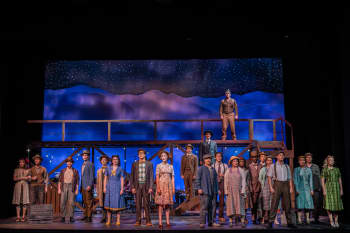
Theatre TCU students brought “Hail Mary,” a new musical, to the stage this past fall. (Theatre TCU)
Theatre TCU students brought “Hail Mary,” a new musical, to the stage this past fall. (Theatre TCU)
Production of "Circle Mirror Transformation." (Theatre TCU)
Production of "Circle Mirror Transformation." (Theatre TCU)
Theatre TCU brings “The Odyssey” to the modern age. (Theatre TCU)
Theatre TCU brings “The Odyssey” to the modern age. (Theatre TCU)
Theatre TCU is both an academic department and an organization that stages multiple productions each year. That dual identity makes hitting pause on the program impossible.
Instead, the department plans to adopt a model similar to professional theatre. Shows will be rehearsed in one location and performed in another, often in rented venues across the city.
Some productions will take place in temporary black box spaces, while others will move into established theatres in Fort Worth.
For students, that shift introduces both uncertainty and opportunity.
“I do think our productions will be affected just with having new spaces,” sophomore acting major Preston Brown said. “But I don’t think our performance quality is going to falter. We can rise to the challenge.”
For many students, the biggest concern is not the art, it is the logistics.
While the renovation is underway, students will travel between TCU’s main campus and off-site locations, balancing rehearsals, classes and core coursework.
“When trying to fit in core classes and thinking about travel times, it’s going to impact our schedules greatly,” Brown said.
He described the transition as disorienting.
“We will kind of be a fish out of its bowl,” he said.
Sophomore Kimora Caldwell sees the experience as another step in adapting to college life.
“The whole point of coming to college is learning to adapt,” Caldwell said. “Now we’re going to go through that process again, and I think it will make us stronger.”
Still, concerns remain. Students worry about transportation, timing and whether the renovation will be completed before they graduate.
“I wouldn’t want to graduate without seeing the finished result,” Caldwell said.
Despite the scale of the renovation, many faculty members say the building itself has never defined the program.
“I don’t know that the building has that much to do with shaping us as a department,” said Krista Scott, a professor of voice and acting. “It’s the people and the relationships.”
Shorter echoed that idea, pointing to the program’s long-standing success despite outdated facilities.
“The faculty here is incredible,” he said. “That’s what has kept this program strong, not the space.”

Musical theatre students smile with horned frog pride after their lab. (Theatre TCU)
Musical theatre students smile with horned frog pride after their lab. (Theatre TCU)

Cast of the production "Hail Mary." (Theatre TCU)
Cast of the production "Hail Mary." (Theatre TCU)

Theatre TCU's class of 2026. (Theatre TCU)
Theatre TCU's class of 2026. (Theatre TCU)
The limitations of Ed Landreth have been evident for years.
Faculty describe cramped classrooms, limited rehearsal space and outdated infrastructure that no longer reflects the professional world students are entering.
“At some point, you’re trying to train students in spaces that don’t match reality,” Shorter said. “It’s been time for this renovation.”
The decision to renovate now is rooted in necessity as much as ambition.
According to Soileau, updating core systems such as electrical and mechanical infrastructure triggers required upgrades to accessibility and safety standards. Combined with the building’s age, those updates require a full-scale renovation rather than minor fixes.
The project will also introduce new features, including improved acting studios, expanded classrooms and a modernized performance environment.
From a funding perspective, the renovation reflects a broader university investment in the arts.
“This project is about creating spaces that fully support how students learn and create,” said Angela Strittmatter, director of development. “It’s an investment in students and in the future of the program.”
For faculty like Associate Professor Lydia Mackay, the renovation represents both a farewell and a beginning.
"Ed Landreth Hall is more than just a building," Mackay said. "It's the reservoir that holds the accumulated energy and creative output of generations of artists."
At the same time, she acknowledges the need for change.
“This renovation has been a very long time coming,” she said. “I’m hopeful that when we return, it will better meet the needs of our growing program.”
Students feel that tension as well — caught between nostalgia and anticipation.
“While we are losing what Ed Landreth looked and felt like,” Brown said, “we’re gaining brand new facilities that will elevate our program.”

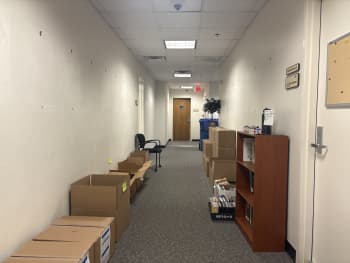
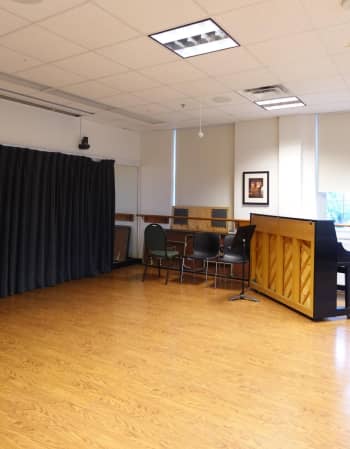
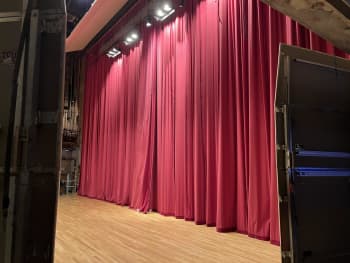
Days before construction begins, Ed Landreth Hall remains the longest home of Theatre TCU.(Heesoo Yang/Staff Photographer)
Days before construction begins, Ed Landreth Hall remains the longest home of Theatre TCU.(Heesoo Yang/Staff Photographer)
In the end, the renovation is not just about new walls, bigger stages or updated equipment.
It is about what continues in spite of disruption.
Classes will still be taught. Performances will still go on. Students will still train for careers in theatre.
Because, while Ed Landreth Hall may temporarily fall silent, the work inside it will not.
“The place is important, but it’s not what makes the program.”
Editor's Note: An earlier version of this article misrepresented a quote from Associate Professor Lydia Mackay. The quote has been corrected.
Photo courtesy of (TCU Alpha Psi Omega)
Photo courtesy of (TCU Alpha Psi Omega)
Photo courtesy of (TCU Alpha Psi Omega)
Photo courtesy of (TCU Alpha Psi Omega)
Photo courtesy of (TCU Alpha Psi Omega)
Photo courtesy of (TCU Alpha Psi Omega)
Photo courtesy of (TCU Alpha Psi Omega)
Photo courtesy of (TCU Alpha Psi Omega)
Photo courtesy of (TCU Alpha Psi Omega)
Photo courtesy of (TCU Alpha Psi Omega)
 Built with Shorthand