
Coffee Consumption and Its Effects Among College Students
Is coffee helpful or harmful for getting them through their days?
By: Yasmine Moussa


It is no secret that coffee is a part of tons of people's everyday lives, especially stressed-out college students. Coffee Affection gathered several statistics relating to coffee intake, specifically in college students. 92% of students consume caffeine and 74% of students drink coffee in the morning, according to Coffee Affection. Coffee increases blood pressure and heart rate, making individuals feel more awake. Since it is a stimulant, it is also routine forming, which is why so many people claim they can't function until they've had their first cup of coffee in the morning. Students are no exception, with over three-quarters, or 74%, reporting that they drink coffee in early hours to fuel their brains and ensure they are attentive in time for classes.
The most common reason for coffee consumption is to help feel awake. However, there are many pros and cons to drinking coffee. The pros of drinking coffee include heightened alertness, reduced fatigue, and it even offers multiple health benefits. In fact, drinking the recommended amount of coffee each day, which is usually one to three cups, lowers the risk of coronary heart disease, diabetes, kidney disease, stroke, heart failure, Alzheimer's, colon cancer, and Parkinson's disease, according to Hopkins Medicine. A healthy adult can have up to four cups of coffee each day, and it is still considered safe. However, some side effects are common when a person ingests too much coffee or drinks it late at night. Insomnia, restlessness, an increased heart rate, nausea, and vomiting can be some of the cons of drinking coffee, according to Web MD.


This begs the question:
Do TCU students think coffee is helpful or harmful for getting them through their days and why?
The research conducted here, which consists of an anonymous student survey distributed online and one-on-one interviews with students conducted in person, strives to address the answer to the question mentioned above on the extent to which TCU students consume coffee.
Student Responses
A total of 57 TCU students were surveyed regarding six questions.
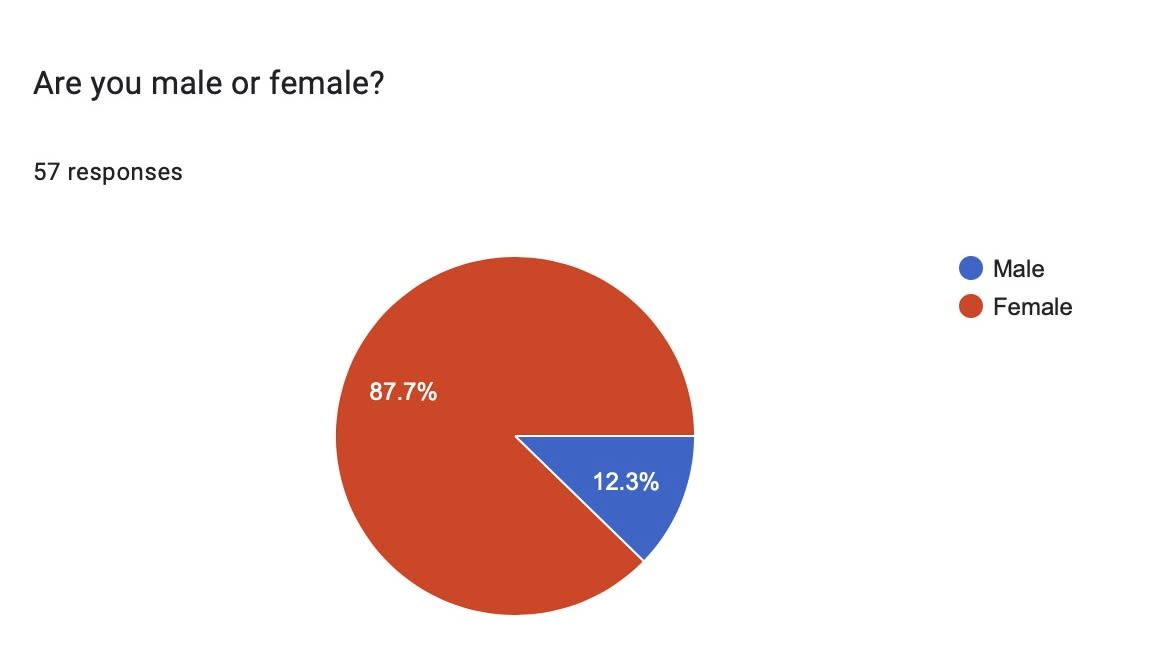
The first question asks if they are male or female, for a sense of demographics.
The results were split between 88% female and 12% male. According to Statista, males overall do drink more coffee than females.
However, the TCU female to male ratio on campus is 60% to 40%, which makes sense as to why there were more female responses.


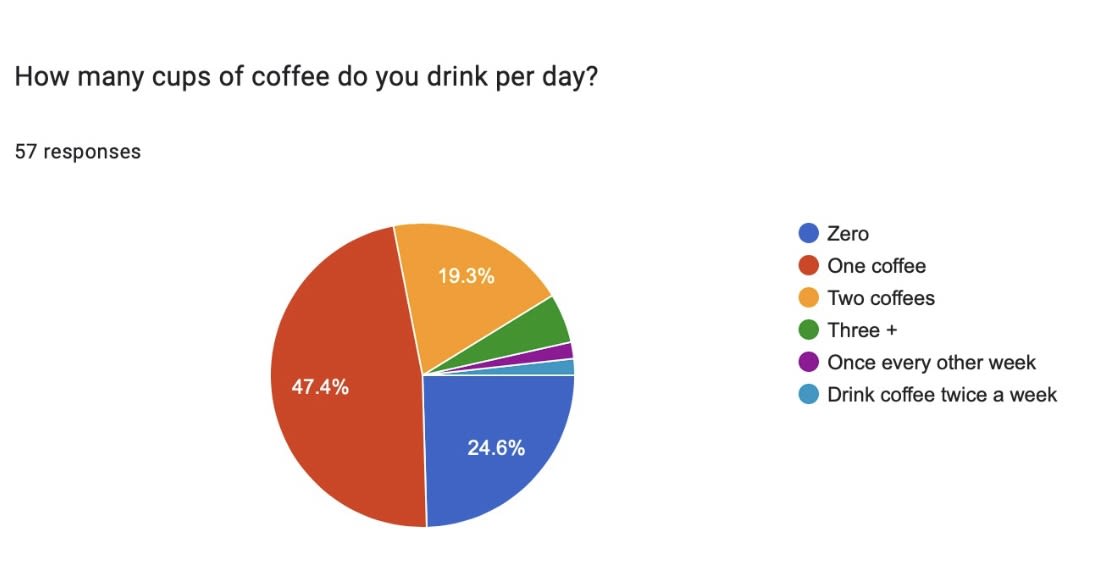
The second question was in regard to how many cups of coffee they consume per day. With the majority of 47% of people answering that they drink one cup of coffee per day, 25% answered with zero cups per day, 19% answered with two cups per day, and 5% answered with three or more cups per day. Again, the recommended dose of coffee is one to three cups per day.

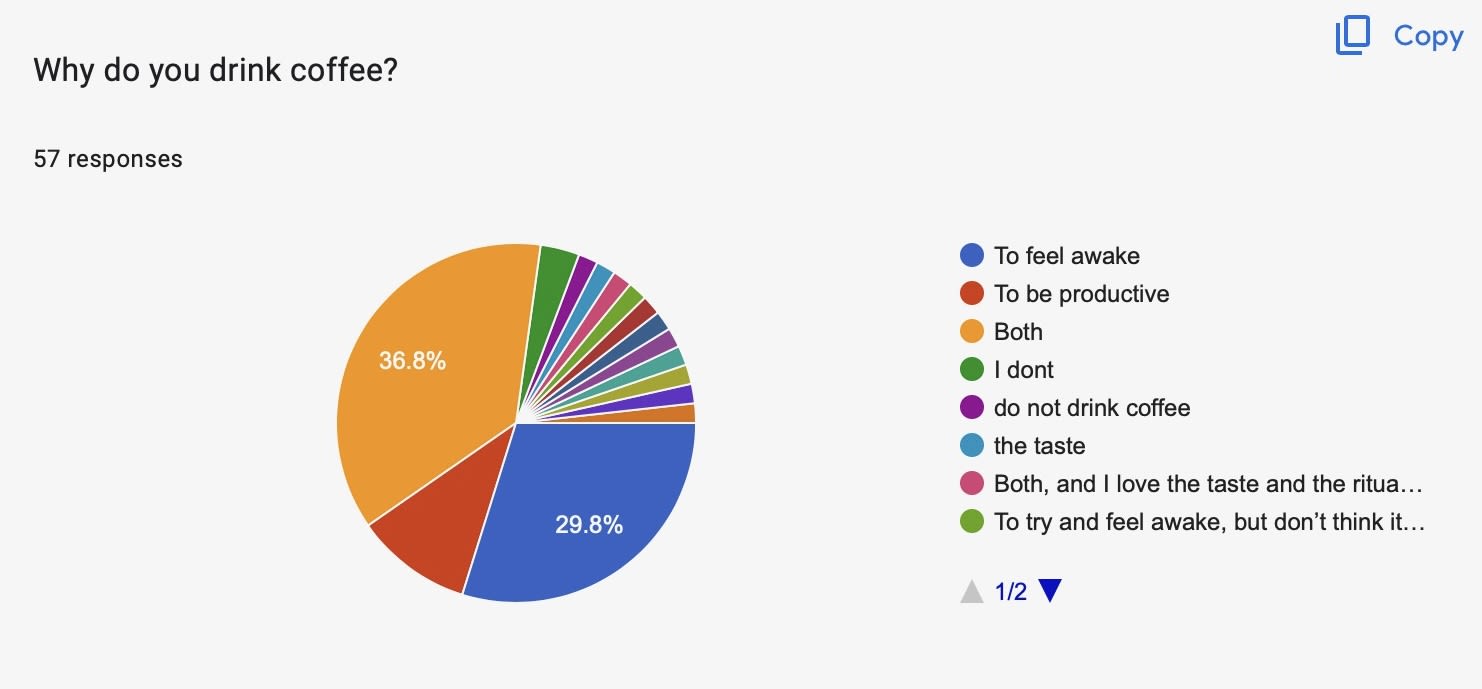
The third question that was asked was the reason for why they drink coffee. 37% of students responded with both to feel awake and to be productive. Following behind, 30% of students responded with to feel awake, and 11% of students responded with to be productive. Other responses included reasons being that they enjoy the taste and simply for the morning ritual aspect of it.

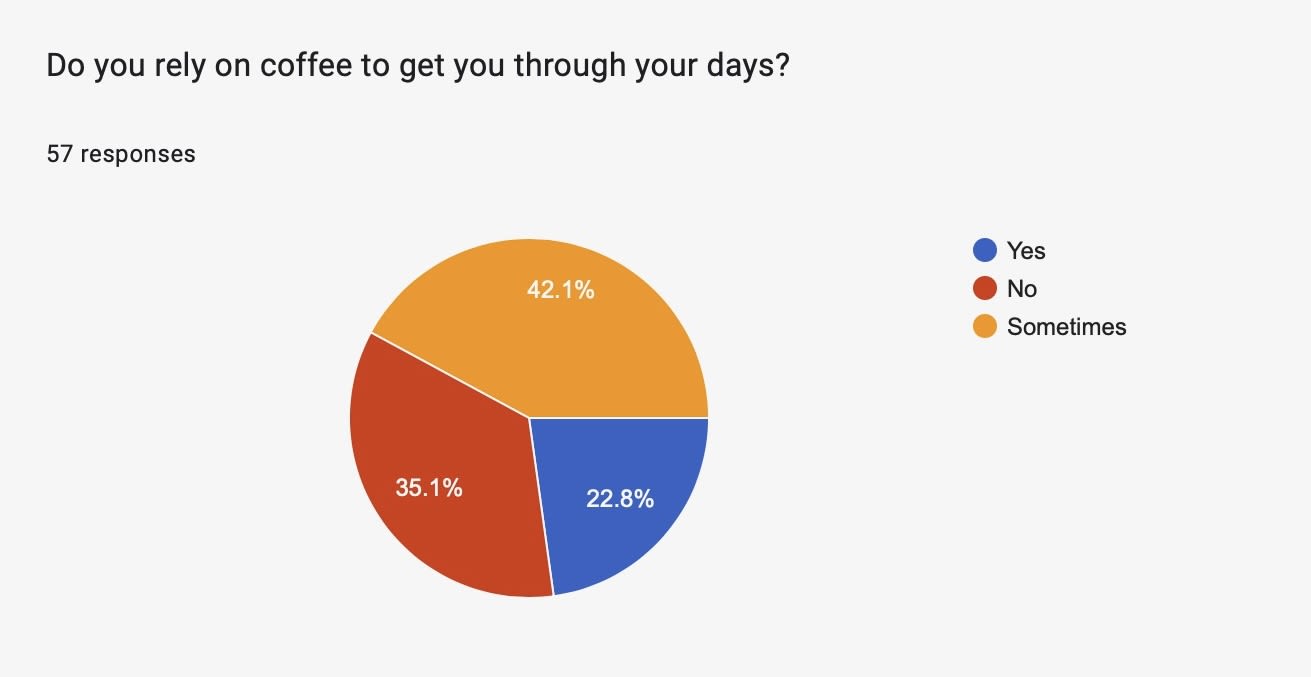
Some individuals may wonder if coffee is addictive, which was the reasoning for my fourth question. The fourth question asked if the students rely on coffee to get them through their days. 24 students responded with ‘sometimes’, 20 students responded with ‘no’, and 13 students responded with ‘yes.’ According to the Addiction Center, caffeinated coffee, in particular, is considered addictive. Due to its fat-soluble and water-soluble characteristics, it enters the bloodstream quickly and easily enters the brain. It can then prevent adenosine receptors, which cause tiredness, while also releasing dopamine and adrenaline. More of these substances are craved by the brain, which can lead to dependency.

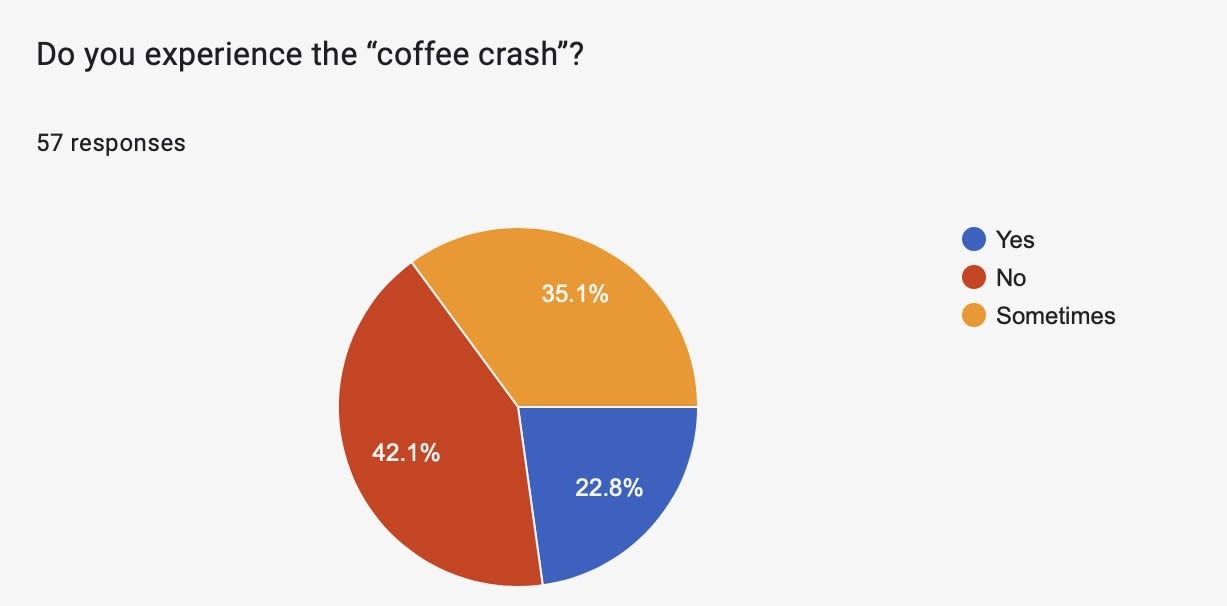
The fifth question asked if the students ever experience the “coffee crash.” The coffee crash is described as a caffeine-induced energy crash that can occur anywhere from 25 minutes to several hours after consuming coffee, tea, or any other caffeinated beverage. It causes excessive fatigue and sleepiness, as well as irritability and inability to concentrate. Due to nausea, mental fog, and headaches, it can sometimes feel like a hangover, according to Balance Coffee. 24 students responded with ‘no’, 20 students responded with ‘sometimes’, and 13 students responded with ‘yes.’
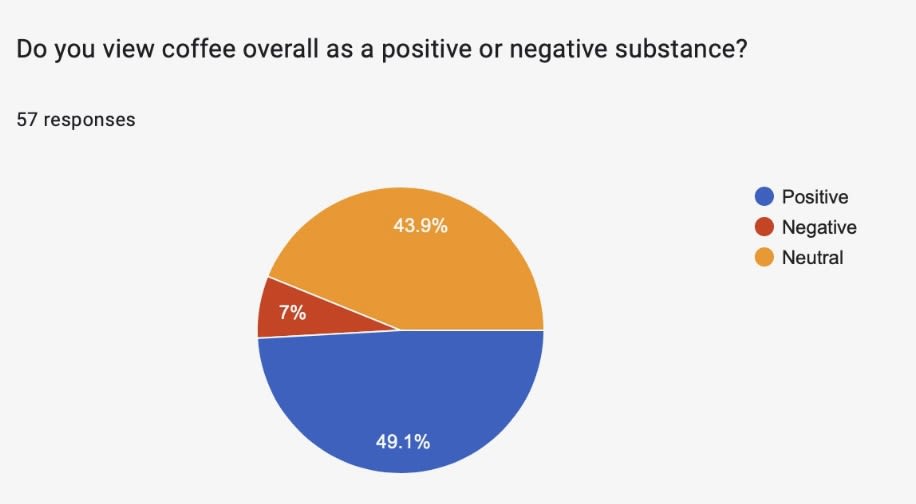
The final and sixth question that was asked was if the students view coffee overall as a positive or negative substance. 49% viewed coffee as a positive substance, 44% viewed coffee as a neutral substance, and only 7% viewed coffee as a negative substance.

Student Perspectives
Mattie Elder, a journalism student at TCU explained her coffee habits.
“I started drinking coffee when I came to college because I literally had so much going on and I need a little boost throughout the day,” she said. Elder is a part of the 74% of students who drink one cup of coffee in the morning as she stated she drinks it in the morning to get her day started.
“I feel like now that I drink it consistently, when I don't have it, I definitely notice a difference, that I don't have as much energy and everything, so I feel like yeah I kind of need it to get through my day,” she said.
Overall, Elder said she views coffee as a positive substance. “I don't really know like the health aspects of it, like if it’s really bad for you or good for you, but like I feel good when I drink it,” she said. “I just think the only downfall is I feel like I kind of rely on it too much, but I think it definitely helps me stay energized and motivated and stuff.”
Lys Marquez, a junior TCU student also shared her coffee habits.
“In the morning, I'm not a morning person, so I feel like once I have a coffee, I'm a little more energized and I can go through the day without a nap,” she said.
Marquez explained how she tends to take multiple naps throughout the day, and she shared that by drinking coffee it makes her more awake and helps her avoid taking those naps.
Overall, Marquez said she views coffee as a positive substance as well. “I feel like it has a beneficial effect on me, but I feel like down the road I might become dependent on it, which could be bad,” she said.
Lance Minor, a junior at TCU explained his “coffee crashes.”
“When I crash, that is the worst feeling ever, one minute I'm excited and the next minute I'm like why are these people talking to me,” he said.
Minor continued by stating that he feels “sluggish” when he doesn’t drink coffee and then when he does drink it, he gets a burst of energy making him feel hyper.
Overall, Minor said that he views coffee as both positive and negative. “It’s positive because it keeps me awake and negative because those crashes be deadly,” he said.
Conclusion
Back to the research question being do college students think coffee is helpful or harmful for getting them through their days?
The result that was concluded is that college students view coffee as more helpful because 77% said that they drink coffee in order to be productive and to feel awake, meaning that the students get more things done throughout their days. Some even drink it just for the morning ritual and because they enjoy the taste. Only 23% of students said that they experience the midday "coffee crash,” which is far less than the 77% who don’t experience it.
In conclusion, 49% viewed coffee as a positive substance, 44% viewed it as neutral, and only 7% viewed it as negative. This research proves the reasoning behind why college students view coffee as more helpful rather than harmful for getting through their days.
Coffee remains one of the most popular non-alcoholic beverages in the world, with millions of people drinking it every day around the country. It is popular for its ability to increase alertness and minimize tiredness, all of which provide clear benefits to college students, and the statistics back this up. Coffee is quite popular, and appears to be increasing even more popular, among college-age students and, more broadly, 13-18-year-olds.
References
Johns Hopkins Medicine. (2021, October 28) 9 reasons why (the right amount of) coffee is good for you. 9 Reasons Why (the Right Amount of) Coffee Is Good for You Retrieved May 4, 2023, from https://www.hopkinsmedicine.org/health/wellness-and-prevention/9-reasons-why-the-right-amount-of-coffee-is-good-for-you
Juergens, J. (2023, February 10). How coffee can rewire your brain for addiction. Addiction Center. Retrieved May 4, 2023, from https://www.addictioncenter.com/community/how-even-coffee-can-rewire-your-brain-for-addiction/
MacDonnell, K. (2022, August 24). College students and coffee: 13 statistics to know in 2023. Coffee Affection. Retrieved May 4, 2023, from https://coffeeaffection.com/college-students-and-coffee-statistics/
M. Ridder, & 13, J. (2022, January 13). Total coffee per capita consumption United States by gender 2020. Statista. Retrieved May 4, 2023, from https://www.statista.com/statistics/457420/total-us-coffee-per-capita-consumption-by-gender/
Tuxworth, W. (2023, February 28). Caffeine crash: How to stop energy crash fast. Balance Coffee: Buy Healthy Coffee Roasted In The UK. Retrieved May 4, 2023, from https://balancecoffee.co.uk/blogs/blog/how-to-stop-energy-crashes-from-coffee#:~:text=A%20caffeine%2Dinduced%20energy%20crash,nausea%2C%20brain%20fog%20and%20headaches.
WebMD. (2023). Coffee: Overview, uses, side effects, precautions, interactions, dosing and reviews. WebMD. Retrieved May 4, 2023, from https://www.webmd.com/vitamins/ai/ingredientmono-980/coffee
 Built with Shorthand