Closing the Spanish language gap in Fort Worth
The parents, whose native language was Spanish, brought their child to Cook Children’s because they were worried about stomach pain.
As the medical team prepared to explain the diagnosis, a nurse, who spoke Spanish, stepped in to help. The family declined as one parent said they “felt good with English.”
The conversation moved quickly, as one parent told the other the child had appendicitis.
They watched as their child was whisked to surgery. Based on their conversation, they expected a straightforward surgery and recovery.
But the appendicitis had developed into peritonitis, an inflammation of the abdominal lining often caused by infection or a burst appendix. When doctors began explaining the complications, it became clear that the parents had not fully understood.
The experience at Cook Children’s reflects a broader reality in Fort Worth: language barriers often influence how families navigate care. That gap shapes safety, trust and outcomes in exam rooms across Fort Worth.
The numbers
35 percent of Texans speak a language other than English, according to notes from a 2022 Tarrant County Communication Committee.
Nearly 30 percent of Tarrant County residents speak a language other than English.
According to a national physician survey, only 10 percent of practicing multilingual physicians report frequent non-English language use with patients.
“We want to be able to practice. We also want our patients to be able to practice Spanish and English, to be able to also advocate for themselves and be able to communicate with their physicians.”
Mitchell and two other students started a bilingual language exchange program at the medical school. alongside two students who shared the same concern: Mary Conley and Angel Sheu, third-year medical students.
They saw how often language shaped a patient’s experience and how often it created distance instead of connection. They wanted to build something that could close that gap.
“Our goal is to bring together future health care providers and community members to break down language and cultural barriers in health care,” the students wrote in their mission statement.
They designed sessions, created learning materials, coordinated logistics, recruited participants and reached out to local businesses to collaborate and pitch their idea.
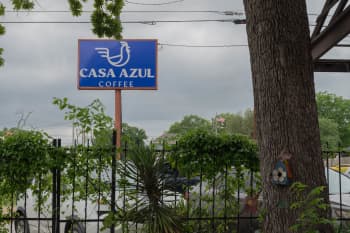
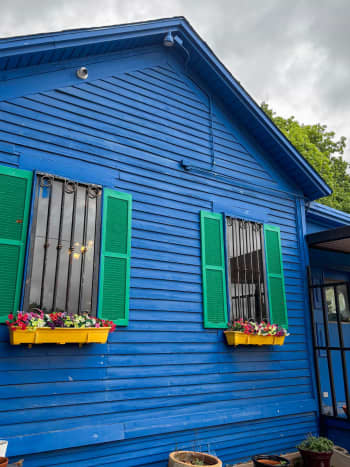
The trio pitched the idea to Casa Azul Coffee, a Latino-owned coffee shop in Fort Worth’s Northside.

A key for participants to decide their language level (learning English or Spanish, or bilingual) as they check in to the program. (Alexis Garcia)
A key for participants to decide their language level (learning English or Spanish, or bilingual) as they check in to the program. (Alexis Garcia)

Denice Rodriguez, a junior biology major at TCU, gives a cultural presentation on the importance of exercise in both English and Spanish. (Alexis Garcia)
Denice Rodriguez, a junior biology major at TCU, gives a cultural presentation on the importance of exercise in both English and Spanish. (Alexis Garcia)

One of the grammar cheat sheets left on each table to aid the bilingual conversations. (Prescotte Stokes III for Burnett School of Medicine at TCU)
One of the grammar cheat sheets left on each table to aid the bilingual conversations. (Prescotte Stokes III for Burnett School of Medicine at TCU)

A table of participants converses over coffee and pastries on the Casa Azul Coffee patio. (Prescotte Stokes III for Burnett School of Medicine at TCU)
A table of participants converses over coffee and pastries on the Casa Azul Coffee patio. (Prescotte Stokes III for Burnett School of Medicine at TCU)
Charlar con Cafecito launched in June 2025 with support from the medical school followed by a Texas Medical Association grant.
Sessions are every first Sunday of the month from 2 p.m. to 4 p.m.
Participants choose their language level at check-in and write their name tag in the corresponding color:
- Green: Bilingual in English and Spanish
- Blue: Learning Spanish
- Red: Learning English
Free drinks and pastries are provided.
Most sessions begin with a short presentation on topics such as nutrition, mental health or cultural traditions. In March, dancers with Ballet Folklórico Azteca de Fort Worth performed.
Some participants had never seen folklórico before, while others were reminded of traditions they grew up with.
The founders say these shared moments help everyone begin on common ground, no matter which language they are practicing.
The crowd includes medical students, undergraduates, ESL learners, community members, health care workers and a growing number of returners.
Soon after the opening cultural presentation, rotations begin.
Participants spend 15 minutes speaking in English, then 15 minutes in Spanish, rotating groups with each timer. Optional vocabulary sheets and grammar tools sit on the tables, and bilingual volunteers circulate to help when needed.
One bilingual participant said they appreciated the timed rotations because they allowed them to spend equal time practicing their skills in both languages.
People return for different reasons. Jenna Williamson, a first-year TCU med student, said she came back because the conversations felt real in a way classroom practice never did.
“It made me less afraid to try,” she said. “Everyone here wants you to get better.”
At its core, Charlar con Cafecito is a low‑barrier, community‑driven space where medical trainees can practice Spanish and cultural humility, and where Spanish‑speaking residents can build English skills and greater confidence navigating health care.
It is a model built on mutual respect, shared learning and the belief that trust grows one conversation at a time.
From cafecito to clinic
The lessons from Charlar con Cafecito follow students into the clinic. The confidence they gain at Casa Azul Coffee changes the way they approach patients, especially when language becomes a barrier.
Mitchell said the program has made her more intentional about how she communicates. “It makes you more aware of how you speak, how you listen and how you check for understanding,” she said.
For others, the shift shows up in moments that require trust.
Conley said even small efforts can change the tone of an encounter.
“When someone is scared or confused, even a few words in their language can change the tone of the whole interaction,” she said. “It shows you are trying.”
Some students have applied their skills in real encounters. Williamson recalled a patient who relaxed visibly when she introduced herself in Spanish. “It wasn’t perfect, but it mattered,” she said. “He opened up more. He trusted me more.”
Faculty members see the impact as well. Students who participate in the program tend to approach patient communication with more humility, said Karla O’Donald, a professor of medical Spanish at the TCU med school and advisor of the program.
“They are not afraid to make mistakes,” she said. “They are more willing to meet patients where they are.”
Karla O'Donald engages in a group conversation at Charlar con Cafecito. (Prescotte Stokes III for Burnett School of Medicine at TCU)
Karla O'Donald engages in a group conversation at Charlar con Cafecito. (Prescotte Stokes III for Burnett School of Medicine at TCU)
“It is not just about learning Spanish, it is about understanding the community we serve.”
 Built with Shorthand