AI in Education


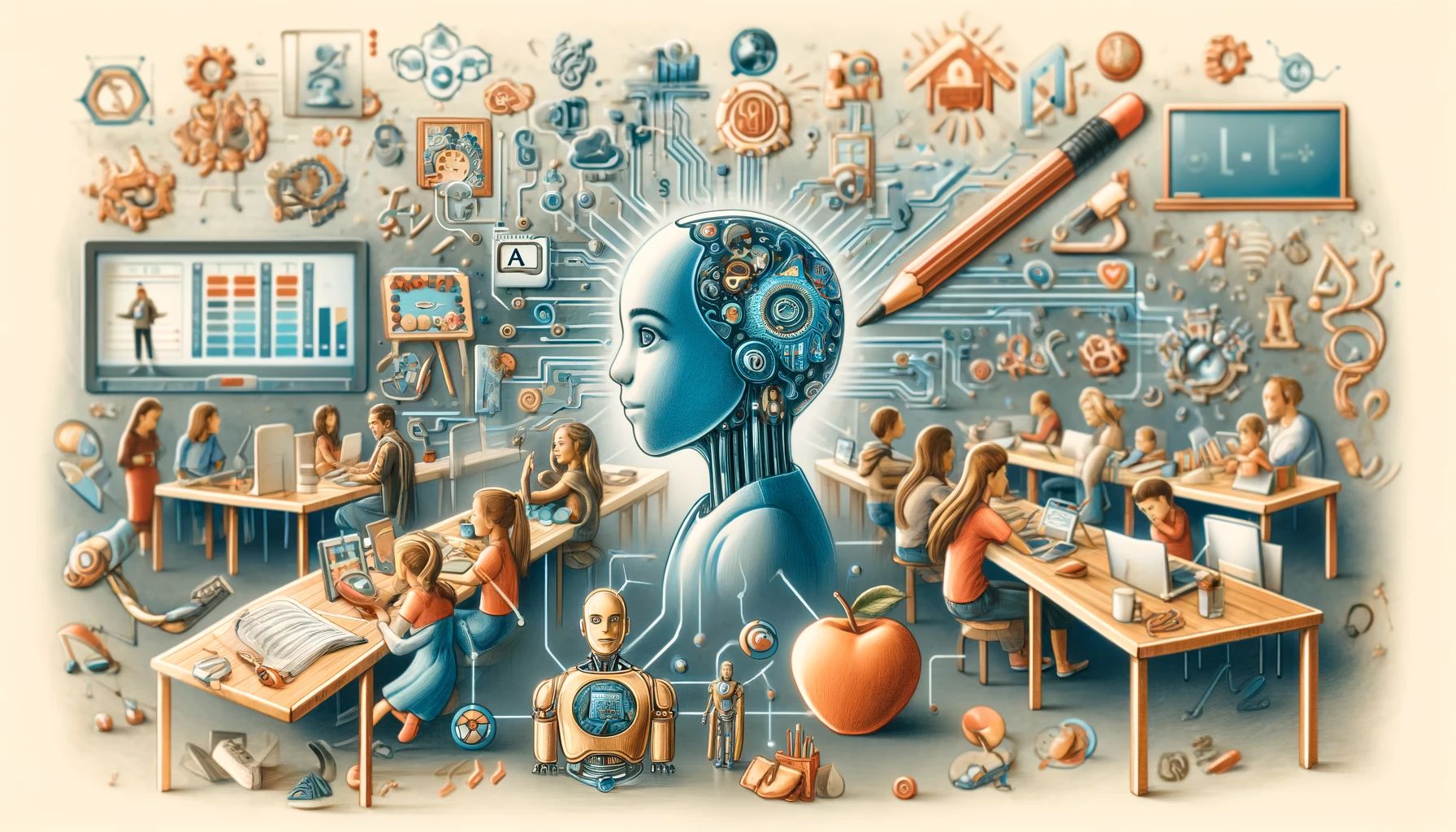
Artificial Intelligence (AI) has rapidly moved from futuristic theory to everyday classroom reality. From smart tutors to essay drafting tools, AI is becoming an integral part of modern education. As students and teachers alike adapt to these changes, opinions are mixed; some embrace the innovation, while others express concerns about overreliance or the potential erosion of critical thinking skills. To explore the impact of AI on education, we interviewed students and professors, analyzed a survey of 30 students, and examined current research to understand how AI is truly shaping learning today.

Research
Artificial Intelligence has been evolving in education for over a decade, but tools like OpenAI’s ChatGPT, Google's Gemini, and GrammarlyGO have brought it directly into the hands of students and educators in ways never seen before. What once required specialized software is now accessible in a browser tab or phone app.
According to a 2023 Pew Research Center report, 58% of U.S. college students said they had used AI tools to help with schoolwork, and over 70% believed it would become standard in classrooms within five years. These tools are no longer viewed as futuristic add-ons—they are becoming everyday companions in learning.
One key benefit of AI is personalized learning. Adaptive learning systems can track a student's performance and tailor quizzes, flashcards, or lessons in real time. Companies like Khan Academy, through Khanmigo, and platforms like Socratic by Google offer AI-driven support for explaining concepts in simple language or answering homework questions on demand.
What concerns might this bring?
However, the growth of AI has also led to rising concerns about academic integrity, data privacy, and critical thinking. A 2024 study by Inside Higher Ed showed that 38% of faculty are worried students are becoming too reliant on AI to complete their assignments. Some universities have responded by creating guidelines for ethical AI use, while others have banned it altogether in specific contexts.
AI is also reshaping the teacher’s role. Tools like Gradescope or GPT-powered grading assistants are being used to speed up evaluation, give personalized feedback, and reduce administrative burden. But this shift introduces new ethical questions: What happens when AI makes a grading mistake? Can an algorithm truly understand nuance or student growth?

Iman Elgusain


Iman Elghusain, a junior at Texas Christian University majoring in Business, shared how AI tools have become a quiet but constant presence in her academic life.
She explains how she is excited about the future in AI but express her concern about how students might be relying on AI and using less critical thinking skills when it comes to problem solving
Iman says that she does use AI but trys to use it in a way that benifits her and not relying on it completley to answer all of her questions.
A paper published by the International Society for Technology in Education (ISTE) noted that, “The goal should not be to use AI because it is available, but to determine where it meaningfully enhances the learning experience.”
There is also increasing advocacy for AI literacy—the ability to use, critique, and understand AI. Organizations like AI4ALL and Common Sense Education are developing curriculum and resources that teach students to question AI outputs, understand algorithmic bias, and recognize the limits of machine intelligence. But where does that leave the teachers?
Dr. Thompson (TCC Professor)
Dr. Thompson, a former professor of mine at Tarrant County College, sees AI as a powerful ally in the classroom.
“AI can be a very helpful tool,” he said. “For example, students can use AI to sift through large amounts of data quickly, find sources, or even get assistance with drafting ideas. However, when it comes to the core learning experience, like critical thinking, problem-solving, and creativity, I think students should still do the work themselves. AI can help facilitate the process, but it shouldn’t do the work for them.”
Dr. Thompson incorporates AI tools into assignments and lectures, showing students how to use them ethically and responsibly. He believes AI literacy is becoming just as important as digital literacy. “It’s about balance. If we teach students how to use AI the right way, it can actually strengthen their learning experience rather than weaken it.”
Do Teachers Fear Being Replaced?
One growing question is whether AI poses a risk to teachers’ job security. A 2023 report from The Brookings Institution explored this and concluded:
“While AI will automate certain teaching tasks—grading, content delivery, and administrative logistics—teachers remain irreplaceable due to their ability to foster motivation, adapt to diverse student needs, and build relationships.”
In a separate 2024 EdWeek Research Center survey of 1,000 K–12 teachers, only 17% believed AI might fully replace them, while 68% saw AI as a support tool rather than a threat. Teachers noted that emotional intelligence, real-time classroom management, and nuanced feedback are skills AI cannot replicate effectively.
Professor Arvind Narayanan, a computer scientist at Princeton University, summarized this distinction clearly in an interview with MIT Technology Review:
“AI can write a quiz. But it can’t look a struggling student in the eyes and know what kind of encouragement they need.”
Nonetheless, educators also stressed the importance of preparing for change. In response, professional development programs are emerging to help teachers learn how to use AI to enhance, not undermine, their role. Organizations like ISTE and AI4K12 now offer workshops and certifications focused on ethical and creative AI integration in the classroom.
Professor Stephanie Robinson
Professor Stephanie Robinson also encourages her students to explore AI in their coursework.
“I’ve been thinking a lot about how AI might impact the future of teaching,” she said. “It’s true that AI can now do things like grade essays, provide feedback, or even generate lesson plans. That raises questions about what role teachers will play.”
Despite those concerns, Robinson sees opportunity, not threat. “Teachers bring something AI can’t: empathy, intuition, and adaptability. We guide students in ways that require human understanding. I don’t think our jobs are in jeopardy, but I do think we’ll have to evolve. Maybe our role becomes more like a coach or mentor.”
She actively integrates AI into her classes and teaches students how to use it as a research assistant, not a shortcut. “My goal is to help them learn how to think critically with AI, not let it think for them.”



Student Survey
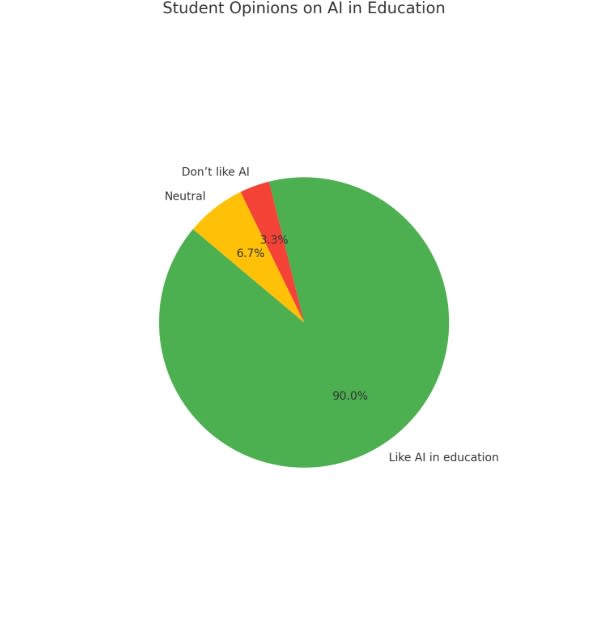
To gauge broader student opinion, a survey of 30 college students was conducted. Participants were asked whether they liked having AI incorporated into their education.
- 27 students said they liked using AI in school.
- 1 student said they disliked it.
- 2 students said they were neutral.
As the pie chart above illustrates, a vast majority of students (90%) have a favorable view of AI in the classroom. Many cited efficiency, ease of access to information, and help with writing as top reasons. The one student who expressed disapproval mentioned concerns about academic integrity and dependency.
This data suggests a growing comfort with AI among students, although the neutral and dissenting voices point to a need for ongoing discussion about boundaries and best practices.
Our Daily Lives
AI is all around us—quietly embedded in the tools we use every day. Whether it's recommending content, correcting grammar, organizing schedules, or answering questions, AI is integrated into nearly every computer, phone, and classroom. In education, it powers learning platforms, writing assistants, and even grading systems, all designed to simplify tasks and enhance how we learn and teach. It's no longer a distant concept—it's part of our daily routine.


Conclusion
As AI becomes an everyday fixture in education, from assisting students with homework to helping teachers manage their classrooms, its influence is undeniable. The perspectives shared by students and professors show that while AI offers powerful tools for simplifying learning and enhancing productivity, it must be used thoughtfully. Most students welcome AI in the classroom, and many educators see it as a supportive partner rather than a threat. Still, with that convenience comes the responsibility to preserve the core values of education: critical thinking, creativity, and genuine human connection. The future of AI in education looks bright, but only if we guide its growth with purpose, ethics, and balance.


Works Cited
- Anderson, Monica. "Artificial Intelligence and the Future of Teaching and Learning." Pew Research Center, 2023, www.pewresearch.org/internet/2023/05/15/artificial-intelligence-and-the-future-of-teaching-and-learning/. Accessed 12 Apr. 2025.
- Lieberman, Mark. "How AI Is Changing Teaching and Grading in Higher Education." Inside Higher Ed, 2024, www.insidehighered.com/news/2024/01/23/how-ai-is-changing-teaching-and-grading-higher-ed. Accessed 12 Apr. 2025.
- “AI and the Future of Work.” The Brookings Institution, 2023, www.brookings.edu/research/ai-and-the-future-of-work/. Accessed 20 Apr. 2025.
- Gewertz, Catherine. "Most Teachers Don’t Fear AI Will Replace Them. But They Are Wary." Education Week, 2024, www.edweek.org/technology/most-teachers-dont-fear-ai-will-replace-them-but-they-are-wary/2024/03. Accessed 20 Apr. 2025.
- Metz, Cade. "Princeton’s Arvind Narayanan on the Limits of AI in Education." MIT Technology Review, 2024, www.technologyreview.com/2024/02/05/princeton-narayanan-ai-education-limits/. Accessed 20 Apr. 2025.
- “Artificial Intelligence in Education: A Human-Centered Approach.” International Society for Technology in Education (ISTE), 2024, www.iste.org. Accessed 25 Apr. 2025.
- “AI4ALL – Education for an AI-Powered World.” AI4ALL, www.ai-4-all.org. Accessed 29 Apr. 2025.
- “Common Sense Education: AI Literacy Curriculum.” Common Sense Media, 2024, www.commonsense.org/education. Accessed 29 Apr. 2025.
 Built with Shorthand