
Fort Worth PD equipped for life
Six shocks in 15 minutes
Terrence Parker’s story
The Fort Worth police officer collapsed on the tile floor of the men’s room.
“Go, Rocsana!” Another officer in the restroom shouted for help.
“Go, Rocsana!”
Officer Rocsana Ferren, the department’s fitness coordinator, rushed from her office at the Bob Bolen Public Safety Complex.
“Go, Rocsana!”
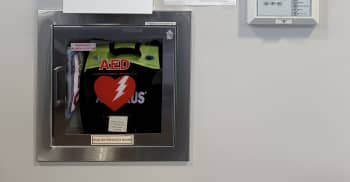
Ferren had grabbed an AED — a device that delivers an electric shock to restore a heart’s rhythm — before she even reached Terrence Parker, who had experienced a “widowmaker” heart attack, due to its high mortality rate.
Within two minutes, officers began CPR while Ferren prepared the AED.
By the time medics arrived and administered a medication that restored Parker’s heart rhythm, he had been shocked six times.
At one point, a tear ran down his face; an officer told him he wasn’t going anywhere.
Parker had been clinically dead for 15 minutes.
The Bob Bolen Public Safety Complex functions as the headquarters for FWPD and the Fort Worth Fire Department. (TCU 360/Shaffer Dale)
The Bob Bolen Public Safety Complex functions as the headquarters for FWPD and the Fort Worth Fire Department. (TCU 360/Shaffer Dale)
Parker recovered, but without CPR and the AED, he could have suffered severe brain damage due to the lack of oxygen in his brain.
“He's pretty lucky,” said Dr. Bruce Bowers, a cardiologist and co-founder of Texas Cardiovascular Specialists. “To be down that long with no good circulation… he's very fortunate, no doubt about it.”
Heart disease is the leading cause of death worldwide. Every year, roughly 350,000 cardiac arrests happen outside of the hospital, and only 10% of victims survive. Low survival rates are linked to limited access to AEDs, lack of bystander CPR training and delayed emergency response times.
“For every minute that the person does not receive CPR, they lose about a 10% chance of survival,” said Jenny Eyer, the vice president of community impact for the American Heart Association of North Texas.
The rollout gains traction
Two weeks after Parker’s incident, Ferren met with the Tarrant County Nation of Lifesavers Committee. A representative from the American Heart Association asked how it could better support the police department.
She suggested equipping patrol cars with AEDs. The committee was surprised the department did not already have them.
“That comment just kind of caught fire, and the next thing I know I’m getting phone calls from the American Heart Association of North Texas,” Ferren said. “It was just that easy.”
Most AEDs cost between $3,000 to $4,500 per unit, according to the American Heart Association.
The American Heart Association of North Texas is raising $250,000 to pay for the rollout. Major donors include the Amon G. Carter Foundation, the Sid W. Richardson Foundation and BNSF Railway.
As of April 2026, FWPD had received $108,000. Ferren said the department has met with a vendor and expects to begin distributing 10 AEDs to each of its six divisions. They will be stored in control rooms for officers to grab alongside other equipment. The additional $150,000 will pay for 80 more AEDs to be installed in patrol cars.
“I’m so thankful for the organizations that are willing to donate the money for this cause,” Ferren said. “It will allow this life-saving effort that we didn’t have before, inside the car of the actual first responder.”
Police officers often arrive faster than emergency medical services because they are already patrolling nearby. That faster response time can mean the difference between life and death.
But there are times when CPR is not enough.
“I have had to do CPR inside homes, and I was really worried we were not going to get them back,” Ferren said. “If I’d had an AED in those situations, it may have gone faster, and if EMS hadn’t shown up with that AED, we probably would have lost the guy.”
Stress and hypervigilance in first responders
FWPD has expanded efforts to identify and treat heart issues before a cardiac event occurs. Their wellness program focuses on three areas: physical, mental and spiritual health.
“If you're not in good mental health, the chances are you're probably not in good cardiovascular health, either,” said Bowers.
Police officers and EMS often work together to respond to emergencies. (FWPD Instagram)
Police officers and EMS often work together to respond to emergencies. (FWPD Instagram)
Police officers live in a state of constant hypervigilance that, combined with stress, creates a risk factor for heart disease. In addition to helping the community, having readily accessible AEDs in patrol cars will support the officers.
Parker, who worked out regularly, never worried about his health. He said that before the cardiac episode, he rarely saw a doctor.
That day changed that.
Terrence Parker has become an advocate for cardiovascular health for the Fort Worth community and first responders. (Terrence Parker)
Terrence Parker has become an advocate for cardiovascular health for the Fort Worth community and first responders. (Terrence Parker)
Defibrillators at TCU
TCU has 217 AEDs. They are in campus buildings and patrol cars. In most buildings, AEDs are near main elevators on the first floor. Some residence halls keep them at the front desk. They are also in campus patrol vehicles. Athletic training staff carry mobile AEDs.
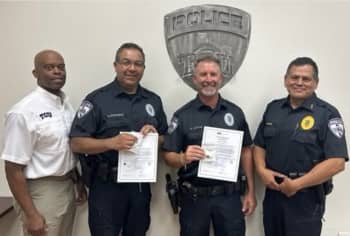
“Annually, the athletic staff and the police department both get CPR and AED training,” said Kim Adams, the assistant vice chancellor for internal audit at TCU. “At the police department, they are all Red Cross certified as first responders.”
AEDs are designed for use by individuals who have not received proper medical training.
The AED will analyze the heart rhythm, tell people to back away, deliver a shock and then reanalyze the heart rhythm. It will continue to deliver shocks as needed until the heart’s rhythm returns to normal.
A mix of fixed and mobile AEDs across campus increases access during emergencies. TCU has had two instances where an AED has been used to save a life. Both cases occurred in athletics, and athletic trainers followed the planned protocols.
“When they are used, they are life-saving,” Adams said. “We have had two uses in the span of 24 years where they were discharged, delivered a shock, and they sustained the individual’s life until emergency support could get there.”
Warning signs
His throat felt icy and tingly as he was loading his patrol vehicle for a recruitment trip.
He had felt it before while working out, but this time was different.
He was in the bathroom, his phone in his hand.
It hit the floor just seconds before he did. The officers around him reacted immediately.
“Heaven is real, I can tell you that,” Parker said. “I heard ‘not yet’ and then I woke up in the hospital.”
Doctors expected severe brain damage. They did not think he would be able to walk or talk again.
Instead, he woke up and gave them the finger.
Ferren said she laughed.
“I was like, yeah, that’s definitely him.”
 Built with Shorthand