
A TCU tradition that endures:
Frog Camp
Origin story
It was the week before classes started in August of 1994.
More than 100 Horned Frogs gathered at Greene Family Camp in Bruceville, Texas, playing “grimy games,” learning the Riff Ram chant and ending their days roasting marshmallows and chatting around the campfire.
They wrapped up the three-day camp by signing their names on a poster that read “best camp ever.”
“That first camp will always be magical,” said Barbara Brown Herman, the founder of Frog Camp. “I watched the school spirit we were longing for come back through those students.”
Worried that the campus lacked a sense of community, Herman said she convinced then-Vice Chancellor for Student Affairs Don Mills to create a bonding experience for incoming first-year students.
Herman said that about 200 miles away, in College Station at Texas A&M, the student experience appeared different. Initially, she modeled Frog Camp after Texas A&M’s fishcamp.
“I knew that Aggies were so full of spirit and had such a sense of community,” Herman said.
Today, Frog Camp is an integral part of the TCU experience. First-year students travel from the Fort Worth Stockyards to international locations every summer.
Over time, it has evolved to meet the changing needs of three generations of students. It provides a place where students can build friendships, play games and immerse themselves in the TCU culture.
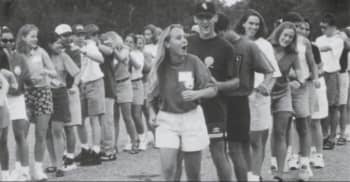
Campers compete in "the spiderweb", which tests students' decision-making and teamwork abilities. (The Horned Frog archives)
Campers compete in "the spiderweb", which tests students' decision-making and teamwork abilities. (The Horned Frog archives)
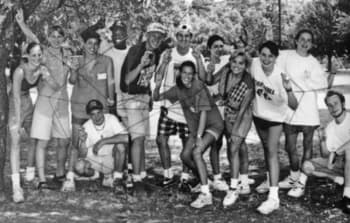
Frog Campers in 1997. (Photo courtesy of Dede Williams)
Frog Campers in 1997. (Photo courtesy of Dede Williams)
Participants at Frog Camp help pull one student over a wall in an effort to build teamwork. (TCU 360 Archives)
Participants at Frog Camp help pull one student over a wall in an effort to build teamwork. (TCU 360 Archives)
Campers bonding at Challenge. (Photo courtesy of Trung Nguyen)
Campers bonding at Challenge. (Photo courtesy of Trung Nguyen)
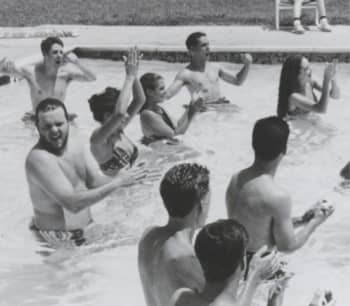
Campers posing in a fountain. (Photo courtesy of Trung Nguyen)
Campers posing in a fountain. (Photo courtesy of Trung Nguyen)
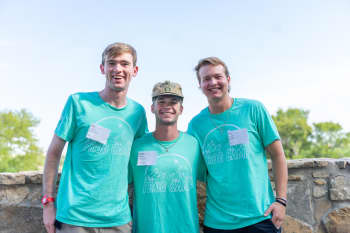
Frog Camp facilitators flexing at Challenge. (Photo courtesy of Eric Shelton)
Frog Camp facilitators flexing at Challenge. (Photo courtesy of Eric Shelton)
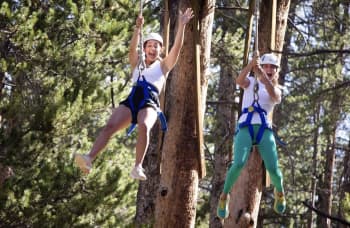
Alpine group with their frogs up on a hike. (Photo courtesy of Lori Dibrell)
Alpine group with their frogs up on a hike. (Photo courtesy of Lori Dibrell)
Campers excited for grimy games. (Photo courtesy of TCU via Instagram)
Campers excited for grimy games. (Photo courtesy of TCU via Instagram)
Campers exploring the Fort Worth Zoo. (Photo courtesy of Eric Shelton)
Campers exploring the Fort Worth Zoo. (Photo courtesy of Eric Shelton)
Foundation for success
Over 80% of incoming students will attend Frog Camp, but it isn’t just a staple of the first-year experience. It’s also a key part of overall student success.
Dr. Trung Nguyen, who was involved with Frog Camp from 2012 to 2022, said students who attended camp stood out.
They were more likely to be retained to their second year and graduate in four years as opposed to those who did not attend, said Nguyen, who is the incoming vice president for student affairs and engagement at Oakland University in Oakland County, Michigan.
“It creates a strong sense of belonging for students with their incoming peers, upper-level students and most significantly with faculty and staff at TCU,” Nguyen, said of Frog Camp. “It’s one of the most referenced traditions or best memories of a TCU alumni.”
This summer, students can choose from seven different types of camps, including Casa Nueva, Challenge, All Stars, Alpine, Mystery, Portugal and Boston. There is a camp designed for students in the honors college that will take place in Vienna.
Some have multiple sessions, while others are only offered once. They run from June to August.
These camps offer many different experiences, but all tie back to the original idea Herman brought to campus over 30 years ago: help students find community.

Frog Camp takes on the Fort Worth Stock Yards during Casa Nueva. (Photo courtesy of Trung Nguyen)
Frog Camp takes on the Fort Worth Stock Yards during Casa Nueva. (Photo courtesy of Trung Nguyen)

Campers white water rafting at Alpine. (Photo courtesy of Madison Pounds)
Campers white water rafting at Alpine. (Photo courtesy of Madison Pounds)

Frog Camp traveled to Iceland in the summer of 2024. (Photo courtesy of TCU via Instagram)
Frog Camp traveled to Iceland in the summer of 2024. (Photo courtesy of TCU via Instagram)
Students who choose a Casa Nueva camp will be immersed in the Fort Worth experience by exploring the stockyards, two-stepping at Billy Bob’s Texas and taking a trip to the zoo.
All Stars is a sports-based camp that gives students an opportunity to experience the professional teams of DFW by attending a Texas Rangers game and learning about TCU athletics.
Challenge takes students back to the roots of Frog Camp. They will participate in “grimy games,” have fireside chats and end the days with s’mores.
The travel camps are the full package. Students get a chance to participate in site seeing, community building and endless opportunities to explore a new city.
Tradition never dies
Dance parties have been a tradition since the first camp.
“The first dance was exuberant,” said Herman as her face lit up in remembrance. “I remember one time at the London camp we had a dance party on a ship with a disco ball… I think we should always have a disco ball.”
While the disco ball didn’t travel back from London, the exuberance of the dance party definitely has.
“My favorite memory from Frog Camp was probably the last night when we had a huge dance party that the facilitators put on in the hotel we were staying at, and I got to talk to so many new people,” said Ella Almrud, a first-year nursing student and summer of 2025 camper.
At each camp, students have the chance to end the night on the dance floor, where student facilitators will lead them in choreographed dances.
“I’m sure people have talked about the dance parties… there is nothing else like them,” said Eric Shelton, a three-year Frog Camp facilitator and TCU alumni. “I remember going to formals and if a Frog Camp song came on, you would see groups of people start doing the dances.”
These dances have become so popular among Horned Frogs that they even appear at alumni weddings.

A late night dance party gets everyone excited for the next day of Frog Camp. (Photo courtesy of TCU via Instagram)
A late night dance party gets everyone excited for the next day of Frog Camp. (Photo courtesy of TCU via Instagram)

Facilitators teach a choreographed dance at the Frog Camp dance party. (Photo courtesy of TCU via Instagram)
Facilitators teach a choreographed dance at the Frog Camp dance party. (Photo courtesy of TCU via Instagram)

Campers join together to end the day with a traditional Frog Camp dance party. (Photo courtesy of TCU via Instagram)
Campers join together to end the day with a traditional Frog Camp dance party. (Photo courtesy of TCU via Instagram)

A Frog Camp dance party is the perfect way to wrap up camp. (Photo courtesy of Madison Pounds)
A Frog Camp dance party is the perfect way to wrap up camp. (Photo courtesy of Madison Pounds)
From fun games to emotional experiences like “place in the circle,” where students of all different backgrounds are celebrated, each moment at Frog Camp has become a tradition that carries on through generations.
“While I truly enjoy the entire curriculum, I would say my top activity would be the one where we labeled ourselves to what we have heard by family members or friends,” said Lori Dibrell, a staff facilitator who works in the donor relations office. “It really opens up the group to communicate and talk about uncomfortable social labels that are often used.”
Moments like these define what Frog Camp is set out to be: an opportunity for first-year students to find their place.
It's a chance to form friendships and get to know people from different backgrounds. It’s also the place where students can express all of their fears and anxieties about beginning their time at TCU.
Staff who have been involved with Frog Camp for years have noticed the focus of camp has never changed, but expanded.
Mike Russell, the associate vice chancellor for student affairs, recalls that in the early days, Frog Camp was a staff-driven initiative with little student involvement. As time went on, he has seen a dramatic increase in student leadership.
Trung Nguyen played an integral role in this shift.
“During my time, it became more of a student success initiative and helped to set students up for success before the first day of classes,” Nguyen said. “It also became more of a leadership role with intentional training and development of student directors and facilitators.”
As the camp continued to develop and gain popularity, accessibility became a priority. Camps located in Texas became free for incoming students and the university now includes fee waivers for travel camps that make it accessible for students from low-income backgrounds.
“I think you would be surprised at how similar it is today to when it first started. We use the same set of activities, same group sizes… it just works.”
A small group spends the afternoon by the lake talking through discussion questions. (Photo courtesy of Trung Nyguen)
A small group spends the afternoon by the lake talking through discussion questions. (Photo courtesy of Trung Nyguen)
Leaving a mark
Even from the moment the first camp began, Frog Camp sparked a shift in campus culture.
“I knew we landed on something within the first five minutes of being there,” said Russel. “The excitement and school pride that had been missing was already visible and is still visible today.”
Its impact has extended far beyond school spirit; it’s helped students make a new location feel like home.
“I was local to TCU, but I knew going to college wasn't going to be comfortable,” said Shelton. “Because of Frog Camp I felt very welcomed, met a ton of people and was actually excited to start in the fall, which was not the case when I first arrived at camp.”
That shift from uncertainty to connection is not unique to Shelton. Many Frog Camp attendees share a similar sense of belonging that begins during their time at camp.
“I felt the closeness of TCU’s community for the first time, and that has never gone away since,” said Almrud.
 Built with Shorthand